
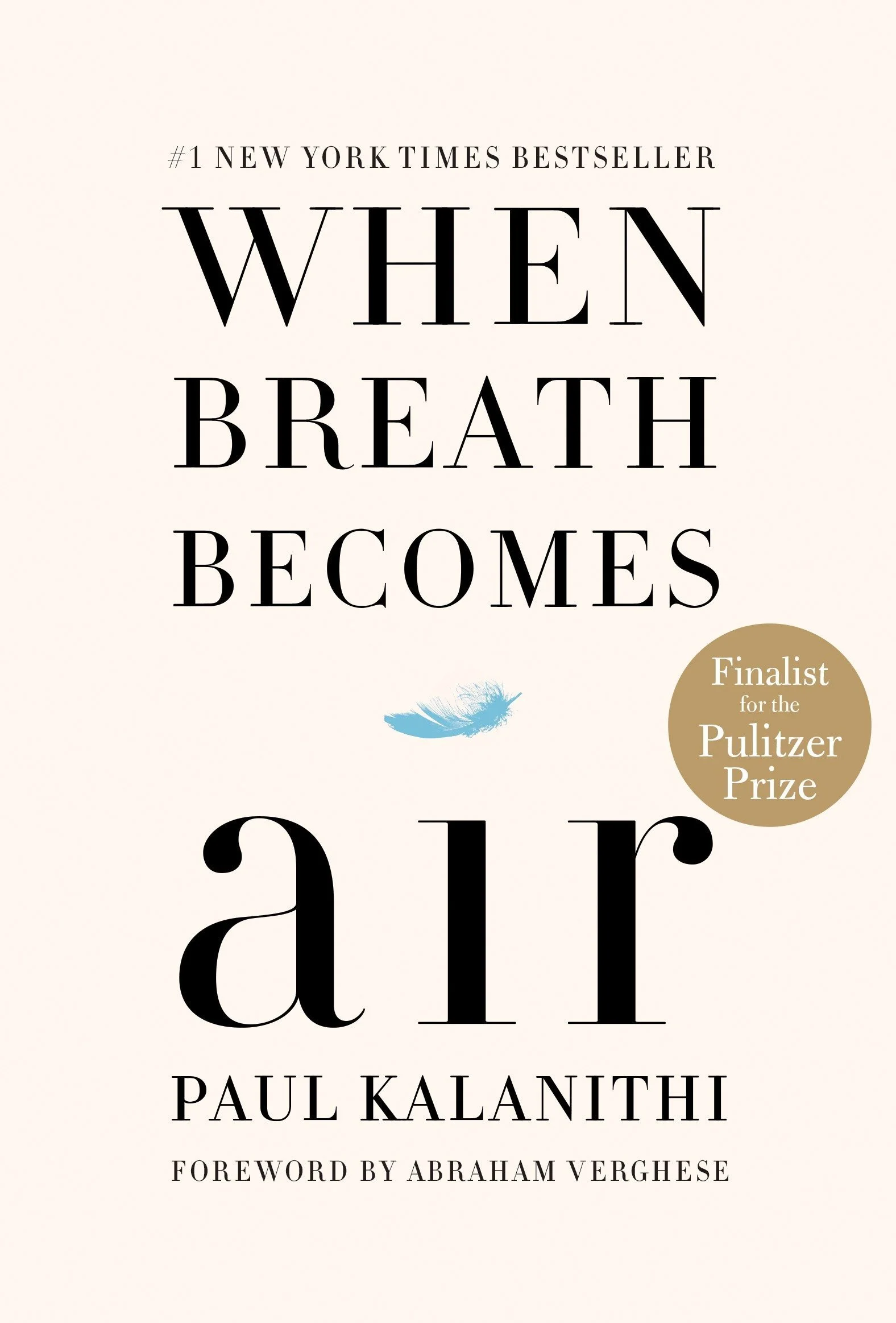
Book Review: When Breath Becomes Air
A reflective review from a ministry perspective
This review was originally written as a seminary assignment for my hospital ministry class.
CEFR Level B2-C1
When Breath Becomes Air is Paul Kalanithi’s narrative about how he became a neurosurgeon and then the time between his diagnosis with lung cancer and his death at age 38. The book is finished with an epilogue by his wife, Lucy Kalanithi.
This type of story is common, so why is this book in particular worth reading? Kalanithi gives us the answer: “If the unexamined life was not worth living, was the unlived life worth examining?” (31) In other words, this book, written by an English literature major doubling as a scientist, is more than the sad story of a brilliant human dying too soon. It is the story of how literature soothes, informs, and inspires life and how one human learned to reconcile what he believed with what he lived.
In the Epilogue, his wife says that Kalanithi lived with cancer “full of hope not for an unlikely cure but for days that were full of purpose and meaning” (219). “Purpose and meaning.” This is the thread that runs through the story and sets When Breath Becomes Air apart from similar books like Kate Bowler’s Everything Happens for a Reason. While cancer certainly disrupts what Kalanithi does and how he thinks of himself, it does not disrupt who he is. This makes for a cohesive narrative that similar books sometimes lack.
Kalanthini lived his life trying to help himself and others live with purpose and meaning. This gives his writing commonalities with the goals of ministry. For example, when describing his boyhood move from the city to the country on pages 22-23, he describes “country facts.” These are things that he believed to be true about life in the country or that people living there told him were true. Their actual veracity varied. “Nothing is more deadly than the bite of the black widow spider” (22). That’s not true for humans, although it is true that black widow venom is extremely toxic when comparing part per milliliter to other venoms. A jackalope, however, is completely fictional (23).
Christianity is full of “country facts.” I have personally met people who are convinced that “cleanliness is next to godliness” is written somewhere in the Bible. More seriously, think about any number of claims that are completely false while containing a seed of truth. One example is that claim that a Christian should, and is able to, be constantly joyful. It is true that God can help us have a perspective and feeling that might not match the situation and it is true that a human can think about things differently and that could have an effect on their feelings, but it is not true that God never wants a Christian to feel sad. Just like with Kalinithi’s country facts, Christians need to spend a lot of time in the relevant environment and with a variety of people in order to separate “sounds like truth” from actual truth.
On page 95, when Kalanithi is reflecting on how he came to understand his role as a surgeon, he says, “I came to believe that it is irresponsible to be more precise than you can be accurate.” My first thought after reading that was, “Clergy should have the same view.”
It seems to me that clergy, denominations, and the like have decided that their job is to speak in certainties. I’m sure that goes as far back as religion itself, but for the US, I wonder if it became especially entrenched in the early 20th century. On pages 187-191 of The Making of Biblical Womanhood, historian Beth Allison Barr writes about how in the early part of the 1900s many Christians thought they had a binary option of either believing that everything in the Bible was truth that expanded past the context and literary genre of the text (in other words, inerrancy) or to completely reject the Bible as having any authority. Given those two extremes, many chose inerrancy.
That background suggests an explanation for why church leaders have a reputation for thinking that they have to have to speak with certainty about all things and why many Christians expect the Church to provide them with certainty. From my perspective, certainty became more important than truth, which led to certainty being equated with truth, which has caused a whole herd of problems.
I wonder what would have happened if instead, Christians decided, like Kalanithi, that “it is irresponsible to be more precise than you can be accurate.” For Kalanithi, this meant not saying with certainty that a patient had a specific amount of time to live or that a disease would definitely progress in a certain way at a certain speed. Those answers may have given a patient comfort, but they wouldn’t have been true in essence even if some of them turned out to be true in fact.
For a Christian, not speaking more precisely than you can be accurate could mean accepting that the Bible doesn’t speak to everything a human might experience, and therefore not saying definitively that the Bible requires a certain action when scripture either never mentions that action or understanding any references to it also requires an understanding of the biblical message beyond a verse or single line of text. If your only answer to a belief, when asked how you know is, “I just know,” or the religious version “The Spirit convicted me,” then maybe that is a belief to speak with certainty only as far as you can speak with accuracy.
I earn a commission if you purchase through The Vareity Page Reads.
Later in the book, when cancer forces Kalanithi to make a decision about who he wants to be, he reflects that “[The oncologist] hadn’t given me back my old identity. She’d protected my ability to forge a new one” (166). Isn’t this the role of faith formation, of clergy in general? Not to give people an identity or to help them stay where is comfortable, but to speak the truth while protecting their ability to form a new identity.
Sometimes Christians go through a significant identity change. These are the types of testimonies that get status. The drunk becomes a Christian and stops drinking. The unethical business person learns that God asks for honesty and justice and changes their business practice, even at a loss of profit.
At other times, perhaps more often, Christians go through longer, less linear identity changes. I think this is the type of change that Kalanithi’s most represents. Kalanithi went through a transition from being a rising star to being a declining patient. At the same time, Kalanithi kept his identity as a person who loved literature, who pursued what he wanted, who was a husband, and so on.
Similarly, a Christian can keep their identity as someone who is committed to Jesus and wants to follow God with all their heart, soul, and mind while also leaving behind the theology and practices that formed their previous identity as a Christian. This process often gets lumped under the term “deconstruction,” but I think that is inaccurate. It may be deconstruction, but it may also be simply growing in faith and obedience to Jesus. I think the role of a clergyperson is to help someone continue that growth and obedience without limiting the person’s ability to form a way of thinking about themself.
Kalanithi’s oncologist continued to provide medical treatment. A clergyperson can continue to provide spiritual counsel. The oncologist supported Kalanithi as he navigated the change in primary identity. My suspicion is that she may have thought Kalanithi should have made other decisions at times, but she respected his agency to change his identity in a way that allowed him to accept his situation. The clergyperson can support a person as they come to understand Jesus differently, even if the clergy person would perhaps hope the person would come to different conclusions.
Similarly, earlier in the book, Kalanithi wrote “I needed words to go forward [defining myself]” (149). This is the value of liturgy and scripture, as well as other forms of literature. When we are searching for a word to define ourselves or our situation, encountering another’s words helps us know what the possibilities are. Liturgy can be a powerful force for good or a powerful force for harm. Choose wisely the words you use.
Equally, Kalanithi himself chose the new words that defined himself. He encountered them in literature, but nothing in his story suggests someone else told him which of those words applied to him. This is something for clergypeople to think about. In a religion that believes in, and for some starts with, transformation, there may be a time for the clergyperson to say the new words of identity for a person. More often, though, I think the role of the clergyperson is to offer access to liturgy, prayers, scripture, and other words that include words of identity and then allow the person to take on the words that they chose. This doesn’t mean that there can’t be guidance, but it does mean that there cannot be control. Instead of telling people their identity, I suggest curiosity. Why do they choose the words they do? Why don’t the clergyperson’s preferred words resonate? Just be careful not to use questions as a way of making the person say what you want so that you can pretend to be giving them agency while actually cornering them into speaking what you want from them.
As I mentioned, this point about searching for identity and professionals preserving a person’s ability to form an identity seems particularly relevant in conversations about deconstruction and reconstruction. The goal of the clergy shouldn’t be to give the seeker answers. It should be to show the possibilities, be honest about the tradeoffs, and always protect the person’s agency to make their own decisions. I say this based on how I understand human psychology and on personal experience, but I think Jesus’ example supports the position. I can’t think of a time when Jesus commanded someone to believe something. He pointed out contradictory beliefs or when words and actions didn’t match. He told people to stop or start actions, but I don’t think he ever told someone that they had to believe something just because God said so. If it’s there, leave a comment and refresh my memory. Like Kalanithi’s oncologist, Jesus helps people see what the options are and then gives them the choice. I think that can be reassuring for clergy, although it may take educational efforts to convince the general public that the role of the clergyperson is not to tell people precisely what to do.
Kalanithi’s story is also relevant to people who are seen as authority figures by people who grieve. There is a scene where Kalanithi delivers bad news to a patient and their family. He concludes by saying that “by the end of the conversation, the family was not at ease, but they seemed able to face the future” (70). Given the severity of a brain tumor, something would be wrong if a family were at ease after hearing their loved one’s diagnosis. Again, when a minister counsels a grieving family, the goal shouldn’t be to make the family feel easy about a bad situation. If the minister can help the mourners face the future, that is a job done well. It’s also a less daunting task than trying to override natural emotions.
Again in the Epilogue, Lucy Kalanithi writes about Paul, “Not with bravado or a misguided faith that he would ‘overcome’... but with an authenticity that allowed him to drive the loss of the future he had planned and forge a new one” (219). As someone who has experienced enough difficulty in life that I do not believe that God definitely will make things better for me today if I just manage to do all the right things, I think Lucy’s statement has a lot to teach Christians, or at least Christians of a certain theological background. “Not with… a misguided faith that he would ‘overcome’.” I feel so much freedom in that statement.
I know some will accuse me of trying to take control and refusing to submit to God. A book discussion isn’t the place to address a theological argument. The most I’m willing to say here is that I tried the submission approach. It has been weighed, it has been examined by scripture, it has been held up to the light given by the Spirit of Jesus, and it has been found wanting. If you are someone who is laboring under the weight of trying to do everything right in order to overcome, please know this burden is not from Jesus. Thinking now especially of cases of chronic or terminal illness, Jesus will still love you, God will still accept you, the Spirit will still advocate for you even if you accept the reality of your experience and stop trying to “overcome.” If you know someone who is disabled or has chronic or terminal illness and you keep pushing them to pray and believe for miraculous healing, please step back for a bit and ask God to show you if your hope in the miraculous is creating a burden humans were never meant to carry.
I’m going to refocus on the book now.
Kalanithi’s story does not have a happy ending, but I didn’t walk away needing to take some time to recover, either. It’s a sad story that is filled with purpose. That purpose lends a tone of hope. Not hope that things will be better, but hope that the worst you can imagine doesn’t remove the presence of good within the bad. I think Kalanithi’s direct acceptance that he was on the fast-track to death helped give the book this tone. If he had spent the book fighting against accepting that he would die sooner rather than later, I think the story would have less hope.
When Breath Becomes Air is a story filled with purpose, meaning, and hope amid unearned, undefeatable evil. If that’s not a metaphor for our life with Christ, I don’t know what is. I’m not saying that Kalanithi wrote a metaphor. I’m saying that the implicit message of his memoir reflects an understanding of the world that many Christians claim is central to their faith.
One thing I appreciated about Kalanithi’s writing is that you don’t know until far into the book why the underlying tone feels similar to Christianity. As I read, I mentally sorted through what I know about different religions and the experiences I’ve had with people who practice Buddhism, Islam, and other non-Christian religions. There is an undertone that suggests some type of religious belief was formational in his life, but until Kalanithi mentions going to church, there was nothing overt enough for me to connect his thoughts to a particular religion.
In the Christianity I’m most familiar with, this would be a problem. In the traditions I know best, Christians are expected to directly and vocally attach God’s name or a scripture passage to events. This isn’t the place to comment on the theology and doctrine creating that behavior. What I will say is that because of my particular background, when someone references scripture during storytelling or uses phrases like “God showed me,” I become less trusting of the storyteller (unless I know them well). I start to wonder how much of their story is them telling things as they experienced and understood them and how much is them doing the very human, and sometimes beneficial, action of adopting ways of speaking that gives them social belonging and status. With that in mind, I perceive Kalanithi’s writing to be authentic and trustworthy because direct references to his faith are footnotes rather than the main point.
We certainly could have a whole other presentation looking at the pros and cons of both approaches, but my point here is simply to bring up the style and tone of the book. Because faith is present but is not put on display, I think When Breath Becomes Air can reach people who wouldn’t read a book where the point is to promote the author’s faith.
That said, as with all media, be thoughtful about who you recommend the book to. Obscenities are used without apology. Not often, but they exist. So, know your audience when making recommendations.
In general, I don’t enjoy the human against nature plotline, but if I were going to read such a book, I would prefer one like When Breath Becomes Air. At its core, the story is the human, Kalanithi, against nature, cancer. But Kalanithi doesn’t write with a focus on that elemental plot. Instead, he focuses on a philosophical question: What makes life meaningful? For him, it was purpose. I think the question and answer is something many people can relate to, and because of that, I think many people could find this book worth the time it takes to read it.
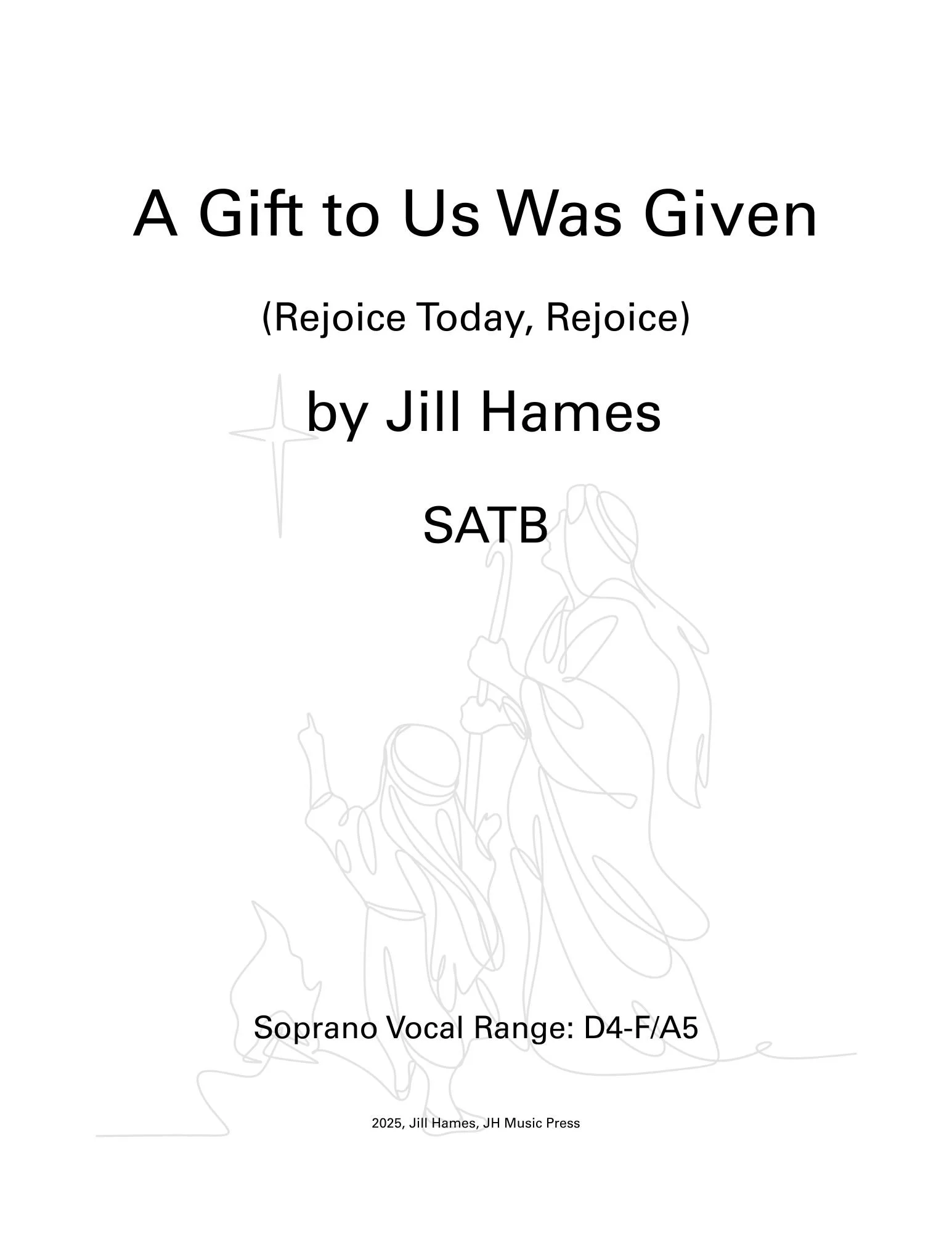
"A Gift to Us Was Given" is the Christmas story in four verses and a refrain. The verses are in D minor, offering peaceful joy as listeners contemplate the meaning of the words. The refrain, in F major, is a joyful response to the significance of what the verses tell. This new Christmas carol in a gentle 6/8 is arranged for be accessible to the average congregational choir, but sopranos have the option of celebrating with A5.
For SATB - Hymn-style arrangement
Key: D Minor, F Major
Soprano/Melody Range: D4-F/A5
Time: 1-2 minutes
Pages in Score: 1
PDF Download
This is a digital product, so I can't issue a refund. If you experience a problem, please let me know.
This title is also available at JW Pepper and SheetMusicPlus.