
An Unintended Consequence
Of limiting emotional experience
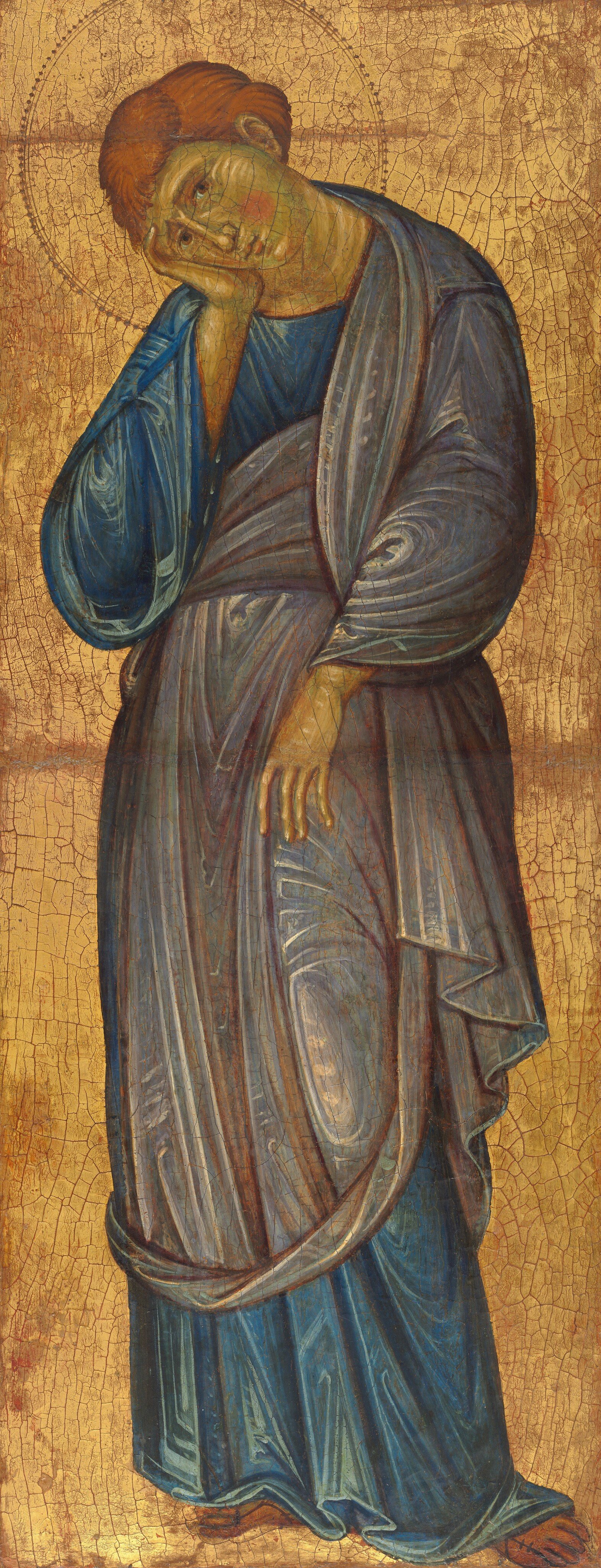
The Mourning Saint John the Evangelist; c. 1270/1275; Umbrian; Master of the Franciscan Crucifixes; Source: The Met
CEFR Level B1-B2
Music: What Do You Think?
“What does it remind you of?” my flute professor asked.
I froze in panic. What was the right answer?
Growing up, I had been thoroughly trained that the correct answer is the one the authority gives and any adult older than you is Authority. (There was no discussion on how this might change when you become an adult yourself.) Disagreement is disrespectful and potentially disobedient. At the same time, if you were wrong, then it was because you didn’t think things through enough, didn’t pay attention, didn’t do something.
How could I possibly guess what this man thought a Bach sonata represented?
My brain scrabbled for a response that was neutral enough that if I were wrong, it was at least a plausible answer.
Sixteenth notes. Eight notes. Allegro.
My eyes landed on a squirrel jumping up a tree. Nature. Music. Music often represents nature.
“A squirrel?” I tentatively offered.
Dr. V valiantly tried to work with that. I learned that “squirrel” was an acceptable answer. I did not learn that it is acceptable, even expected, that you play from your emotions.
Whenever he asked the question, I answered, “Squirrel.” Even if I had to struggle to imagine how “squirrel” and “Adagio” went together, “squirrel” was the answer that didn’t get me corrected. (AKA “In trouble” because I didn’t understand the nuance between a teacher giving corrective guidance and a parent telling you that you were wrong and should have known better.)
Years later, Dr. V reminisced with me, “Remember when your answer to everything was ‘squirrel’?”
I politely smiled along with the memory, still confused about what the right answers were and how I was supposed to know them.
In the years after I graduated with a B.A in Music and let music become a true hobby, I continued to wonder, “What does it mean for this music without words to represent something?”
In time, I decided that since I wasn’t playing for a grade or a paycheck, then the music would represent the scenes that play through my mind when I play a piece. I still didn’t know if this was the right answer, but it made me happy and made the music more interesting to me, so I stubbornly decided that would be what the music meant to me, even if it did mean that I played more expressively than metronomically accurately. It wasn’t like I had an accompanist to play with me, anyway.
Decades after college, I have a piano teacher. (Hi, J!) She started me with the A Dozen A Day series. This series has a line illustration before each exercise. Ms. M always asks me, “What is the picture telling us about how to play the music?”
I’ve personally grown enough that I can give an answer without worrying about whether or not the “authority” agrees with me, even if I sometimes have a mild internal freak out from the remnants of past indoctrination. Even if I’m now willing to give my thoughts, I sometimes struggle to know how the picture represents the music. It’s not a skill I’ve spent much time developing. So, we talk about the picture and the exercise and share theories on how they relate. There is a plausible answer, but not a targeted The Answer. It’s slightly confusing, but also liberating.
I don’t know how I would have perceived the “Huh, let’s explore options” approach as a teenager. Even so, my intuition says that this is a good way to develop the skill of connecting emotions to actions without making the question sound like it’s a test on what the one right answer is.
All this got me thinking about how emotions were discussed in Christian spaces throughout my life and how my theology of emotions, which was connected to my theology of respect, affected secular events like playing a Bach sonata.
Christianity: You’re In Control
Growing up, I developed the understanding that some emotions were acceptable and others were to be grown out of. Happiness and contentment (i.e. compliance without complaint) were good. Frustration, anger, and more than fleeting sadness were signs of immaturity. Anger was absolutely not allowed (because that’s disrespectful and disobedient). In fairness to my parents, I don’t think they intentionally taught this emotional dichotomy. The ingredients were just in the water, so the soup formed.
The ingredients were things like “obey your parents [immediately and without question, ideally anticipating what they want so they don’t have to tell you]” (Ephesians 6:1), “the joy of the Lord is your strength [which means you never have a good reason to be upset]” (Nehemiah 8:10), and “if you pray, God will give you good things [and make it so that your “bad” emotions magically disappear and you’ll be happy no matter what happens [insert convoluted sermon on how we can be joyful even if we aren’t happy]].”
I remember in college saying that I had never felt stressed. Looking back, I think I hadn’t experienced enough uncertainty and hardship for stress to be a strong part of my life. (Despite the previous paragraphs, my parents loved us and did their best to give us security and a life full of experiences.) I also think that I didn’t recognize what stress was. That roiling feeling in my chest, the way my body wanted to curl in on itself when I had to sing during ear training, the feeling that my brain was sluggish because something heavy kept my thoughts hidden? I think those were signs of anxiety and stress. (I’m not sure I even associated the word “anxiety” with emotions back then.)
In my late 20s, I was in a life transition. Nothing horrible, just a time of life not being in my control, including job hunting while not employed enough to support myself. I didn’t have words for what I felt, but as the weeks went on, the only way I could describe it was that it felt like I was in a crater, knowing life and happiness were at the top, but I couldn’t figure out how to climb up there.
I had been raised on “no one can make you feel bad except yourself,” “you’re in control of your emotions,” “if something makes you feel bad, change how you think,” “if you don’t like it, then change your expectations,” and the like. Add in a (un)healthy dose of “pray about it and everything will be better (and if it’s not, what’s wrong with your spiritual life?).”
With all that trained into me as if the claims were as true as the rule of gravity, I was flummoxed at why I couldn’t just change my perception and then have a clear mind and feel happy. Making such changes was second nature to me. But it wasn’t working now. I remember one time, I tried to smile in order to change my emotions by doing the emotion I wanted. I nearly dropped to my knees from the force of the disconnect between what I felt and what I was trying to do. That was when I stopped trying to change my emotions by performing the actions of happiness when I didn’t feel it.
During this time, I had an ongoing conversation with God. I don’t remember a specific prayer or revelation, but I do remember that at some point I was living under the decision that if God made me, that included my emotions and God was big enough to handle whatever I was feeling. The more I let myself envision God seeing me in sadness, numbness, and distress, the more convinced I became that feeling these things is acceptable to God. (Not that God wants us to feel those things, but if circumstances occur and we feel those things as a result, then God doesn’t expect us to miraculously be happy when circumstances don’t warrant it.)
I’m here writing this, so you can confidently know that I was not struck by lightning for letting God see me unhappy and confused. I can also say that I can’t think of a single thing that was God punishing me for having “unchristian” emotions. (I don’t think God punishes people for being human and I don’t think there are “good” and “bad” emotions, but I know some religious spaces give people this impression. I’m living evidence that these teachings are false. Or if you prefer Christian jargon, my testimony is that God accepts us even when we have “bad” emotions and God doesn’t ask us to change those emotions on any timeline.)
Connecting the Threads
When I think about these two story arcs, I have to wonder: If I had felt the freedom to feel my full range of emotions while growing up, would I be a better musician? Or at least better able to verbalize what emotions I wanted a piece of music to express? Would I have been more emotionally resilient as an adult, free from the effort of trying to bend my emotional expressions into what others expected and free from the confusion that came when my desires became greater than my ability to select which emotions to feel?
I don’t think any adults in my life set out to limit my emotional vocabulary or experience. I think their words came from trying to form resilient children who were protected from the thoughtless words of others. I think people repeated what other Christians said without thinking about what the stock phrases mean or what the likely outcome would be.
Christians need to be thinkers. All my experience shows that God can handle questions, emotions, and challenges without making life difficult for the human. Indeed, if we believe that the Christian God is a relational being that is the essence of love, how could we expect anything less?
So, what is an unintended consequence of limiting emotional experience? It’s difficulty with knowing your emotions. It’s unnecessary psychological burdens. It’s challenges with connecting abstract and concrete thought. None of those outcomes bring glory to God. None of those outcomes contribute to human thriving.
If, like me, you became an adult who struggled to understand the role of emotions in an adult’s life, this is my suggestion: Read the Bible for what it says, not what you’ve been told it says. At the same time, read middle-grade coming-of-age novels. Ask God to guide you to God’s truth. If the Bible and prayer parts are more than you can handle right now, read the novels. If God is the source of truth, then all truth is God’s truth and those novels are full of truth about emotions.