
Verbalizing My Mission
AKA Putting my thoughts into words that other people understand
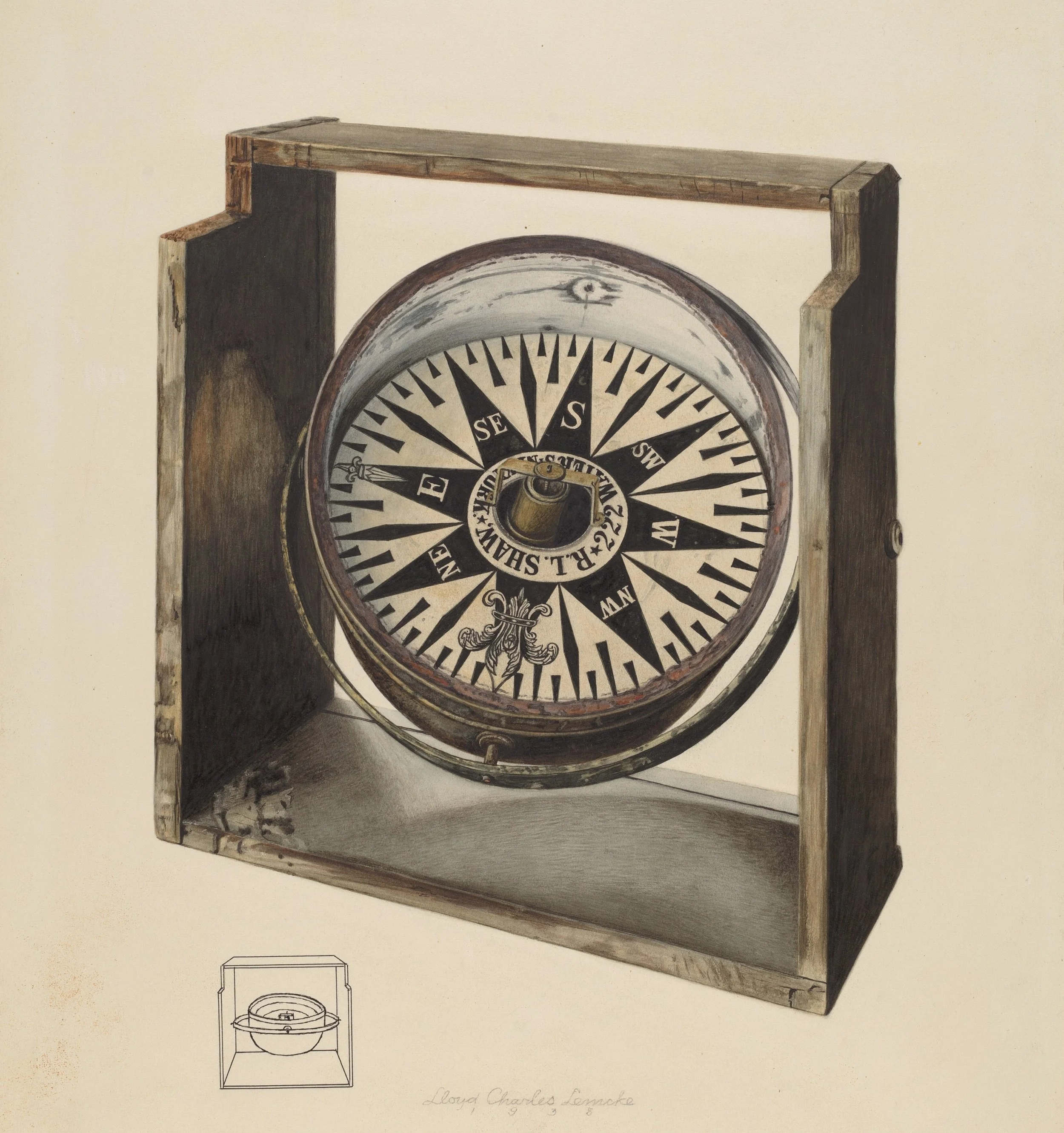
Compass; 1938; Lloyd Charles Lemcke; Source: National Gallery of Art
CEFR Level B1-B2
This was originally published on my Substack, The Variety Page Limited. I’m posting it here, too, since I have more control over my own site and who knows when some Substack AI checker will think my writing isn’t 100% human (it is) and block me.
In early May 2026, I had an on-campus week for my online MDiv program. We were asked to introduce ourselves and say something about what kind of ministry we do or hope to do. I said something like, “Two parts: I hope to teach religion in the community college system and I create biblical studies classes for individuals or small groups.”
A few days later, some of us were talking and I was asked what brought me to the MDiv program and what I hoped to do because “it sounds like you’re still discerning your calling.” I was confused by that description of what I thought was a clear explanation. I was too confused to have words to ask what was unclear in what I said, so I settled for telling the story of why I joined an MDiv program when I don’t feel called to be a preacher (although I 100% believe the Bible supports women in all forms of church leadership and under all titles).
Later in May, Wendy McCaig asked three questions that connect to the calling question. My response felt too long to put in a comment on her post, so here’s my essay.
What do you long to create beyond the boundaries of institutional conformity?
I’m taking "institutional conformity” more narrowly than Wendy means it. For my calling, this term indicates the boundaries we learn by being a Christian in the US, at least in the white evangelicalism tradition, which is what I’m most familiar with. Those boundaries are a whole lot of “don’t.”
I want to be part of freeing people into the “do.”
A key step is helping people take the risk of asking questions when the answer might mean the Church has misled you. I think God likes it when you ask questions sincerely or push back on what you’re taught because you truly want to understand (e.g. Judges 6, Mark 7:24-30). Sure, there are some examples in the Bible where God sounds frustrated (e.g. Joshua 7), but often, God accepts human fears and challenges and gives the person what they need to feel better. Questioning means you care. God created humans to have a brain that thinks and wonders. I think it’s insulting God’s gift to refrain from using that ability.
Stemming from that, I write and create classes for people who can understand sentences with more than one conjunction and who are unintimidated by words they don’t know, or who are willing to develop those skills through practice. I’m sure there are other people who are called to give adults the intermediate steps that take them from wherever they are to the ability to understand my work. No one can serve every role, which is why all are needed.
Related to that concept, I think there is a role for church, but I don’t think we should take church, or rather church leaders, as the ultimate authority on what pleases God. If it is true that the Spirit lives in all who chose to follow Jesus as the boss of their life and supreme ruler of the universe, then each person has something to say in what church should be, which doctrines are consistent with scripture, and how to understand the things that the Bible leaves unclear.
In all of this, I don’t want people to be afraid of God. Honor, respect, acknowledgement of power beyond human comprehension - these are suitable responses towards a being that is more powerful than us and beyond our full understanding. Huge waterfalls like Niagara and Murchison scare me, but I’m not afraid of them, if that makes sense.
When I read the Gospels, I see a God (and I believe Jesus was God) that likes people. I see it in the Old Testament, too, but it’s more obvious in the Gospels. The church talks a lot about God’s love, but I think there’s a place for talking about how God likes us. I don’t mean “like” as an equivalent to “full approval at all times, no matter what.” The closest analogy I can get is when someone likes music, for example. You might not like all music all the time, but as a class of something that exists, you always like music. The analogy breaks down when I think about how someone might never like a certain type of music. I don’t want to imply that God doesn’t like certain types of humans - that’s reprehensible. A god like that wouldn’t be worthy of following. Someone help me out with an analogy?
All that sounds like high-level theology. More practically, education for adults, particularly through writing and classes that require cross-disciplinary thinking without taking ourselves too seriously, is where I feel gifted and others have confirmed my talents here.
Education often brings freedom. I also think education can change some underlying beliefs that will affect greater change. There is room for working against specific problems, like the hierarchical equal-but-different gender teaching, but what are the underlying beliefs that make that teaching not immediately sound like nonsense 1,000 miles away from what God wants?
Connected to all this, I want to help people learn to ask questions and find answers from reliable resources. This taps into my previous career as a librarian, as well as one of the first things you learn in middle school English: What’s the inherent bias of this source? Why can you trust them/not trust them? I extend that to: Why is your metric for trust/distrust reliable? What is the outcome of different beliefs? Should we continue to trust a source when the outcome is inconsistent with a God who loves and likes people? Why do we think that if someone claims to be a Christian and uses Bible verses to back up their ideas, then that person is by default reliable (this includes when you evaluate me)?
The boundary I live outside of is the one where people view the Church/clergy as the ultimate source of truth for things about God. They are a source, but not the only one.
Another boundary I live outside of is the idea that Christianity/religion/spirituality will have the answer to all things. In big principles, sure (e.g. love your neighbor). In the details? Sometimes, we have to do the best we can, knowing that we can’t know a definitive answer. At the same time, we shouldn’t give up looking because we don’t know what we don’t know.
Is this creative energy rooted in your own lived experience?
Yes.
The Christianity I was given proved insufficient to the task of living outside the carefully controlled environment in which it was taught.
I am constantly saddened and astounded when I meet someone who is scared to ask questions, who says they have to claim a belief they don’t have because their church says they have to, or who have been Christians for decades and haven’t read the whole Bible or don’t know basic (to me) biblical content. Why do so many people give their self-agency to someone else?
How can others join you on the journey?
If you know me in person, talk to me! For everyone, comment on what I write. Support me through a paid Substack subscription, Buy Me a Coffee, or buying a class. Share my class page with someone you think might be interested. Ask me to teach a class for your small group. Share my work and credit me.
Less directly: Be brave enough to ask the question and to go looking for answers in places that might scare you.