
Goldenrods: Facts and Thoughts
Edited and combined into one long post September 2026
Originally published as short posts August 2023
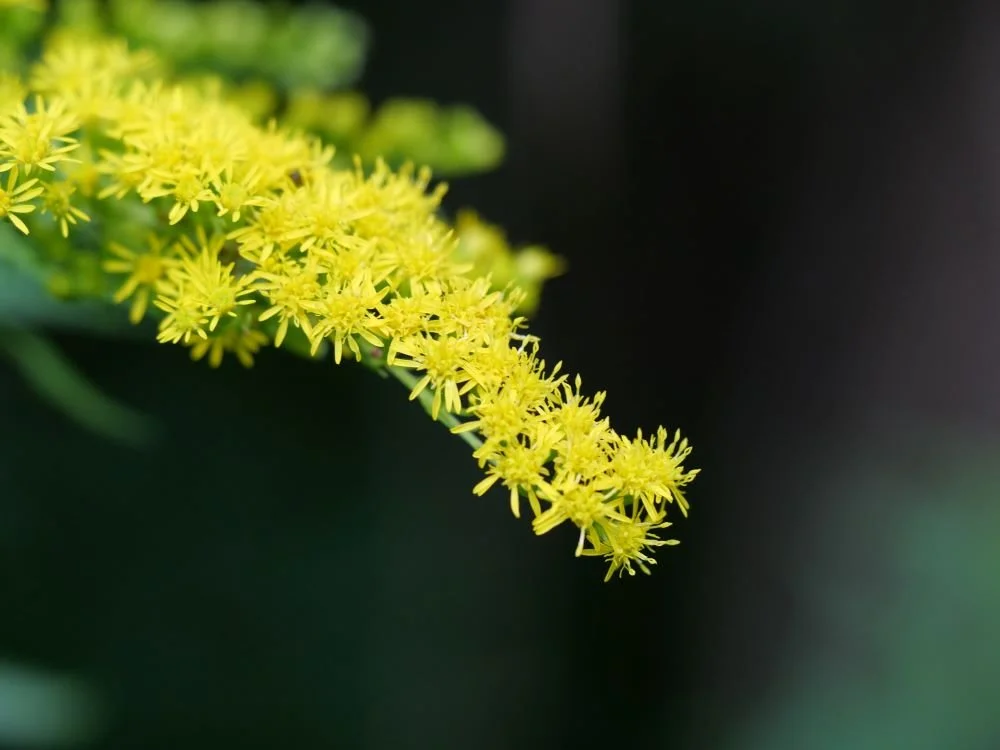
Goldenrod flower inflorescence (many little flowers on one stem); Photo: Jill Hames, 2023
CEFR Level C2
Six Facts
Goldenrods are a quintessential wildflower in late summer and early fall in Virginia. The tall, slender stems sag with the weight of their yellow flowers and brighten up roadsides, abandoned fields, and the edges of woods. Often seen from a speeding car, how much do you know about goldenrods?
Goldenrods (solidago spp.) are part of the Aster family (Asteraceae).
Goldenrod flowers seen on the roadside as I drive past don’t look anything like an aster, but when I get up close, I see the similarities.
Goldenrod flowers usually have a ray or disc shape.
From a car window, goldenrod flowers look more like tubes or random fluffs, but up close, you can see the petals arranged in a circle. They look very similar to aster and daisy blooms.
Goldenrod flowers are usually yellow.
It makes sense that plants with yellow flowers on a skinny stem would come to be known as goldenrods. In Virginia, an exception to the yellow flower is the silverrod (solidago bicolor), which has white flowers.
The peak blooming time for Goldenrods in Virginia is September.
Goldenrods start blooming in August and some will continue into November, but in general, September is when most varieties are in full bloom.
There are about 40 species of goldenrods native to Virginia.
This doesn’t mean that all species are native to all counties of Virginia. The Digital Atlas of the Virginia Flora is a good resource for finding out if a plant is native to a specific county.
Goldenrod pollen is unlikely to cause allergies.
This is because the plant is pollinated by insects. That means that its pollen isn’t usually blown around by the wind. If the pollen isn’t in the air, it is unlikely that you are breathing it in or getting it on your skin. If you aren’t coming into contact with the pollen, it's unlikely that you are experiencing allergies from the pollen. Of course, you should always consult a doctor before making healthcare decisions.
Goldenrods are a cheerful sight in late summer and early fall. Whether you enjoy them cultivated or in the wild, goldenrods that are native to Virginia are beneficial for natural cycles and for beauty. Let’s enjoy the view!
Legends
Like most plants, goldenrods have their share of folklore attached to them. Here are a few found online.
A Fairy’s Gift
In one fairy tale, a stick offered itself to an old woman to use as a walking staff. When the old woman left the stick behind, she sprinkled it with fairy dust and it became the goldenrod. Read the full legend from this post in the Sun Gazette.
A Witch’s Trick
In this story, two sisters asked a witch for help because they never wanted to be parted as they grew older. The result was goldenrod and chicory (or purple asters) blooming at the same time of year and in similar habitats. Read the full fairy tale in this post from Dave’s Garden.
Goldenrod Means Money, or Maybe Water
According to the Farmer’s Almanac, the presence of goldenrods means there is buried treasure under them. Or maybe it means that the closest house will experience prosperity.
On the other hand, goldenrod might also mean there is a spring nearby. Or maybe frost is coming.
Goldenrod Makes Rubber
If science legends are your interest, some say that Thomas Edison had a Model T with tires made from the rubber found in goldenrod.
If this sprinkling of goldenrod lore intrigued you, search for “goldenrod legends” and “goldenrod folklore” to learn more. Remember, check any medical suggestions against logic and modern scientific knowledge. Just because something was used to treat an ailment, that doesn’t mean it produced the desired effect.
Four Ways to Use in Decorating
Goldenrods can, of course, be used in flower gardens and landscaping, but they can also be used for indoor decorating.
Stems of goldenrod can be used as fresh cut flowers.
It is suggested that you cut the stems before the flowers bloom. Otherwise, they could turn into seeds within a few hours, even when the stems are stored in a vase of water. Since goldenrod pollen isn’t usually the type to become airborne, this could be a good choice of flower when you don’t want pollen falling on your tablecloth.
Goldenrod flowers can be used in dried flower arrangements.
Dried goldenrod flowers typically keep their bright yellow color. Loose flowers can be dried and kept in clear glass jars as decorations for your rustic autumn décor. Dried stems of goldenrod can be used in vases or with other dried flowers in an arrangement. If you dry your own, be sure that they are completely dry to avoid mold growing or rotting stems.
Goldenrod stems can be used to make wreaths.
You’ll need a wreath form and some wire to tie the stems on. Again, if you’re using fresh flowers, be sure to keep an eye on the drying process and remove any rotting or molding stems.
Goldenrod stems can make swags and garlands.
I haven’t tried this, but if goldenrod can be bent around a wire wreath frame, then stems of goldenrod, full of yellow buds, would make a festive garland for birthday parties, September weddings, or an autumnal equinox party.
As a nature lover, I have to request that if you’re harvesting more than a few stems, that you plant your own goldenrod specifically to cut for decorations or buy from someone who has cultivated the plants for this purpose. Wild plants look abundant, but overharvesting can make them disappear, as well as the beneficial wildlife they support.
Used By Many Animals
Here is an incomplete list of the many different types of animals that rely on goldenrod.
Insects that Pollinate Goldenrod
Moths
Butterflies
Bees, including bumblebees and other bees native to the U.S.
Wasps
Beetles
Flies
Each type of insect has different species that may use goldenrods. Finding and listing them all out would be too much for a short overview like this article.
Animals that Eat the Leaves of Goldenrod
Rabbits
Garden Experiments says that turkey and ruffed grouse eat goldenrod leaves, but I couldn’t find other sources to confirm this.
White-tailed deer may eat the leaves of goldenrod, but it’s not their preferred food.
Animals That Eat the Seeds of Goldenrod
Foxes
Grouse
Opossums
Pheasant
Racoons
Songbirds
Squirrels
This list comes from Garden Experiments, but I couldn’t find other sites to confirm that all these animals eat goldenrod seeds. It seems likely that these animals would eat goldenrod seeds, though. I know the gray squirrels in my backyard will eat almost anything plant based.
Animals That Live On Goldenrod as Larvae or Nymphs
Flies, various species, like the Goldenrod Gall Fly
Moths and butterflies, various species
You can go down the rabbit hole of Wikipedia looking at the different species of insects that use goldenrod.
Animals That Eat Insects Living On Goldenrod
Assassin bugs
Parasitic wasps
Chickadees
Spiders
Woodpeckers
Sources
Missouri Department of Conservation
Goldenrods: A Sonnet
The yellow flowers, sunny as the summer day
A bendy stalk, whorled with leaves ascending
A buzzy friend, pollen to its legs appending
Could any sweeter view before me lay?
The many petals, set in the form of a ray
And bud after bud, and buds unending
A brilliance to the field ever lending
What plant is this? Please tell me, please do say.
Egg-yolk yellow, fuzzy summer flowers
Moths and birds, those rabbits, too, living in the leaves
It thrives in barren sod
This plant, many insects does empower
This autumn beauty, once truly known, deep love breeds
It’s lovely goldenrod.

"That's Why You Were Born" is a modern Christmas carol that could also be used as an Advent song. The verses summarize the Nativity story. The refrain creates anticipation. The ending answers the "so what" question. This is a hymn-style SATB arrangement that offers flexibility in mixing soloists with full choir or congregation. This would be a fun piece for the choir to sing while actors perform a Christmas pageant.
Length: 1:00-2:00 minutes
Soprano/Melody Range: Bb3-F5
PDF Download: This is a digital product, so I can't issue a refund. If you experience a problem, please let me know.
This title is also available at JW Pepper and SheetMusicPlus.