
Because They Don’t Know
So they can’t teach

Portrait of a Woman; 2nd century; Egyptian 2nd Century; Source: National Gallery of Art
CEFR Level B2-C1
“Most people simply don’t know.” (The Making of Biblical Womanhood, Beth Allison Barr, 69) When I read this at 6:15 on a Friday morning, I felt the weight of something true and in the pause to absorb that weight, the sketch of this essay appeared in my mind.
I come from Christian traditions where seminaries are looked at suspiciously while someone claiming to feel a call of the Spirit to go into ministry is met with unexamined applause. Bible college is the only openly-approved option, if you must risk indoctrination by entering higher ed. Better to go to YWAM’s Discipleship Training School or a similar program. Never, ever go to a state school if you want to retain your faith. Then when someone becomes a pastor, there is no community expectation of continuing education.
I believe that it is possible for someone to self-educate, but it takes intentional, ongoing work. In my opinion, it is problematic that religious communities lack the expectation that a church leader demonstrates that they are educated in theology and related topics and that the church leader demonstrates that they engage in continuing education. The lack of knowledge combined with an underlying fear of the other, means that people think a church convention is as good an educational opportunity as a class at seminary, maybe better. “Learning” often means reading all the books that agree with each other and repeat the same ideas. This lack of education, and lack of understanding what education is, shows in preaching, theology, doctrine, and practices. I say this with deep care for people I know who have become pastors in this way. I trust their intent is to love and follow Jesus with all their heart, soul, and mind. I say this with concern and care for the church leaders who went to seminaries and other institutions where questioning and disagreement were discouraged. They just don’t know what they don’t know. How can congregants learn when their leaders have insufficient education? (Yes, I used “lack” three times in a paragraph. I know this isn’t good writing technique. I’m leaving it in with the hope that it is evidence that AI did not help me write this. This essay was written on my own. No generative AI was involved.)
I earn a commission if you purchase through The Vareity Page Reads.
“Most people simply don’t know.” This is why I will say things like church being the tax you pay in order to have a chance at meeting people with similar values. If that insults church leaders, I hope it also pushes them to ask why I make that statement. I think church can, and should be, more than the equivalent of paying to attend a mega discount sale in the hopes of finding something you want at a price that justifies the cost of admission. I’m not talking about tithing here. I’m talking about the time and energy that goes into attending church. Tithing/giving is a whole other topic for another essay. Maybe my metaphor only makes sense to me. Regardless, now you know that at least one person thinks the holistic cost of attending church rarely justifies the benefit and also thinks that it doesn’t have to be that way.
“Most people simply don’t know.” This is why I talk about Bible translations and how they are influenced by who is on the committee and what the theological purposes of the translation are. This is well documented across multiple sources (Marg Mowczko is one starting place). Now you know that Bible translations matter and what you believe could be influenced by the translation you read.
“Most people simply don’t know.” This is why I write. No one knows what they don’t know. Plus, a person can only focus on so many things at once. Maybe you don’t know about Junia being a woman because you were busy figuring out if you can be a faithful Christian while believing evolution is the best explanation for how the physical world came to be. Maybe it never occurred to you that devout Christians can have different views about science and the Bible because you were busy learning about what the Bible does and doesn’t say about gender and marriage. Maybe you were studying why some parts of Christianity are so focused on believing the right thing that they forget to do the right actions. So I write what catches my interest, even though readers and algorithms don’t like a lack of focus. I write in the hopes that an essay will catch your imagination, will show you that maybe, you simply don’t know
“Most people simply don’t know.” How can anyone know if they aren’t told? I know it takes discernment to know when and how to speak. Still, if no one speaks, no one can know. Without knowledge, people perish, literally and metaphorically.
“Most people simply don’t know.” Now you know. What will you do?
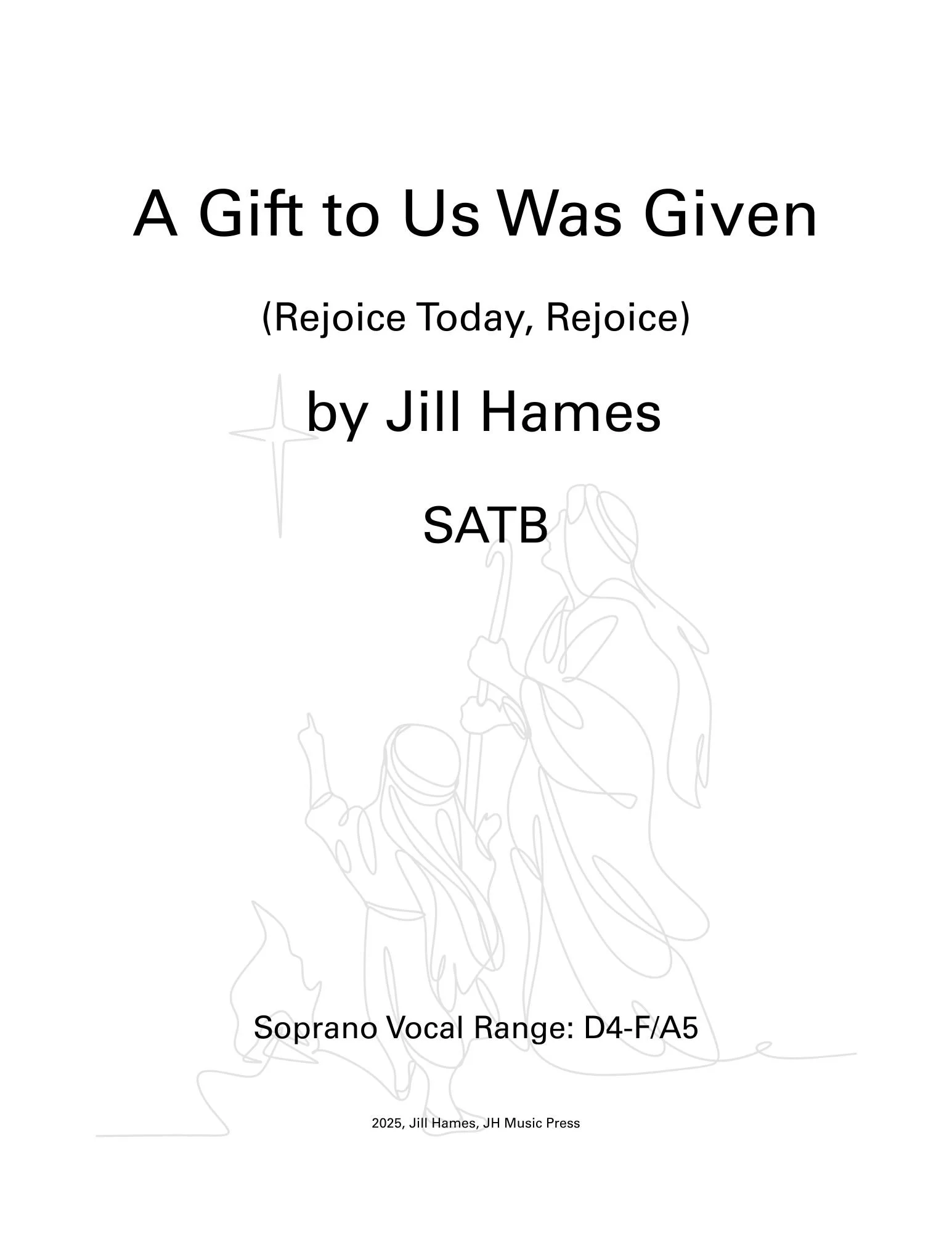
"A Gift to Us Was Given" is the Christmas story in four verses and a refrain. The verses are in D minor, offering peaceful joy as listeners contemplate the meaning of the words. The refrain, in F major, is a joyful response to the significance of what the verses tell. This new Christmas carol in a gentle 6/8 is arranged for be accessible to the average congregational choir, but sopranos have the option of celebrating with A5.
For SATB - Hymn-style arrangement
Key: D Minor, F Major
Soprano/Melody Range: D4-F/A5
Time: 1-2 minutes
Pages in Score: 1
PDF Download
This is a digital product, so I can't issue a refund. If you experience a problem, please let me know.
This title is also available at JW Pepper and SheetMusicPlus.