
It’s Not a Switch That Can Flip
What we devoted our lives to doesn’t change just because an authority figure said so*

Saint Catherine; 1522; Venetian; Lorenzo Lotto; Source: National Gallery of Art
CEFR Level B2-C1
As part of my hospital ministry/mentored chaplaincy class in seminary, we are reading, among other things, Being Mortal by Atul Gawande. I read this when it first came out because I was the 20-something who wanted to write a will and a 30-something who wanted to have an end-of-life packet that I would update occasionally. I have yet to get those to whom it would matter to accommodate preparations inspired by my apparently strange acceptance that at some point, I will die and my desire to have some say over that (if a proposed life-saving procedure means that afterwards I likely will not be able to learn things with a clear mind and talk about ideas with others, then just let me die). In the meantime, I am re-reading Being Mortal.
In Chapter 2, Gawande tells the story of an 85-year-old woman’s visit to a geriatrician (a doctor who specializes caring for the elderly - a profession that Gawande says is in steep decline (36)). In Gawande’s summary of the visit, he says that the woman did not seem to be eating enough calories to maintain muscle strength and the woman admitted that she had lost seven pounds in the past six months (41).
The first thing I noticed is that the woman knew how much weight she had lost. The most likely reasons are because she somewhat regularly weighed herself or she had doctor’s appointments where weighing happened and she paid attention to the number. However the weighing happened, the end result was that this woman knew her weight and how it changed. She was paying attention to her weight. Why? We can’t know, but it isn’t surprising to find a woman who pays attention to their weight.
With my understanding of fashion, social, and health history, I think it’s reasonable to assume that the woman spent much of her adult life, if not also her teenage years, being told that gaining weight is bad and losing weight is good. Even if she was old enough in the 1940s-50s to form an aversion to the thin female figure, after about 50 years of being told fat is bad, it may never have occurred to her to be concerned about her weight loss. It’s also possible that this was the first time her adult daughter heard that weight loss could be anything other than healthy. After decades of social and medical messaging warning people about gaining weight, how is this woman supposed to start feeling good about eating more than she feels like so that she doesn’t lose weight? A switch doesn’t flip just because an authority figure said that things are different now.
I want to think about this from the perspective of spiritual formation.
An 85-year-old woman is talking with her minister. “I’ve gone to church all my life. I pray, do devotions, memorize scripture, attend Bible study, and volunteer in the church kitchen,” she says.
“From all that time spent with God, how would you explain God to someone?” her minister asks.
“I am the way, the truth, and the light,” she responds, attempting to quote John 14:6.
“True, but what is God like?” her minister presses.
“God is love.”
Her minister tries from another angle, “What’s been your experience with God?”
“He’s all I need,” she recites.
“Can you tell me a story about you and God?”
“I’ve been a Christian for 80 years. I was baptized when I turned 12. God is good. Jesus loves me. When I do what I’m supposed to, God blesses me. I know that trouble is just God trying to teach me a lesson, so even though I don’t like it, I’m not mad at God. I always do my best to do what is right and find joy in all things.”
The woman doesn’t seem to understand what her minister is asking for, so the minister attempts to demonstrate how to tell a more personalized story. “One time, I decided to be really honest with God. I told God that I thought praying was boring. I didn’t understand how this was supposed to be a conversation or form a relationship. I kept reading the Bible, but if I didn’t have anything to say during my designated prayer time, then I just didn’t. I had been taught that not praying would make me farther away from God. What I’ve discovered is that God isn’t nailed into one place. God knows that I’m willing for God to come along with me wherever I am, so God does. I say this because I never feel like God is far away. I might not understand why certain things happen or I might wish God would interfere more directly in my life, but I don’t feel far from God.”
The woman looks politely scandalized. The minister wonders if that was too much honesty and decides to give her time to think about what’s been said.
“What about next week, you can tell me a story about you and God?”
How do you think the woman will respond?
Will she be able to tell a story in natural language or will she fill it with Christianese and half-quotes from scripture?
Will she be shocked that her pastor was so candid about not having a prayer practice that fits what is touted as desirable?
Will she scold the pastor for not parroting the lines of certainty?
If she’s spent a lifetime learning which phrases to recite when asked about her relationship with God, then a switch won’t flip just because someone asks her to think more personally.
Let’s think about our hypothetical woman’s comment:
“I know that trouble is just God trying to teach me a lesson.”
If that is what she believes, then what might she say to try to comfort someone at a funeral? Anything I think of is somewhere between insensitive and downright cruel.
Or what about how she answers personal questions with scripture quotes. If that’s what everyone around her does, then how was she supposed to learn anything different? Even if there are variations, if people who quote scripture are socially considered to be better Christians, then why would she be motivated to develop her own way of expressing her thoughts?
If the devotionals, sermons, and other Christian media mostly tell her that emotions are deceitful or that she needs to rely on the Spirit rather than on what she thinks and feels, then how is she supposed to learn to know what she thinks and feels?
After a lifetime of learning that formulas are personal expressions and that truly personal thoughts are sinful, a switch won’t flip just because her current minister invites her into something different.
This post is long enough and the more I write, the more I think this topic needs more thought than can happen in an essay. My point with these examples is not to condemn anyone. I do, however, think it would benefit Christians to think about what they believe and the spiritual habits they have formed.
Is there a likely context when what you’ve learned to do and say would cause you to behave in a way inconsistent with kindness and the other fruits of the Spirit? If so, how will you flip the switch? Or better, in my opinion, how will you change how you think and what you do now so that you’ll have the desired result later? If you don’t know what the desired result is, start figuring that out.
If the desired end result is that you can cite the church-approved responses, regardless of the impact on yourself and others, then start asking why impact doesn’t matter.
The TLDR version is: People do what their social systems train them to do. If we want different outcomes later, then the systems now need to change. We can start by tracing a line from the behavior that is rewarded in the current systems and comparing it to the behavior we know or predict will produce the desired later behavior.
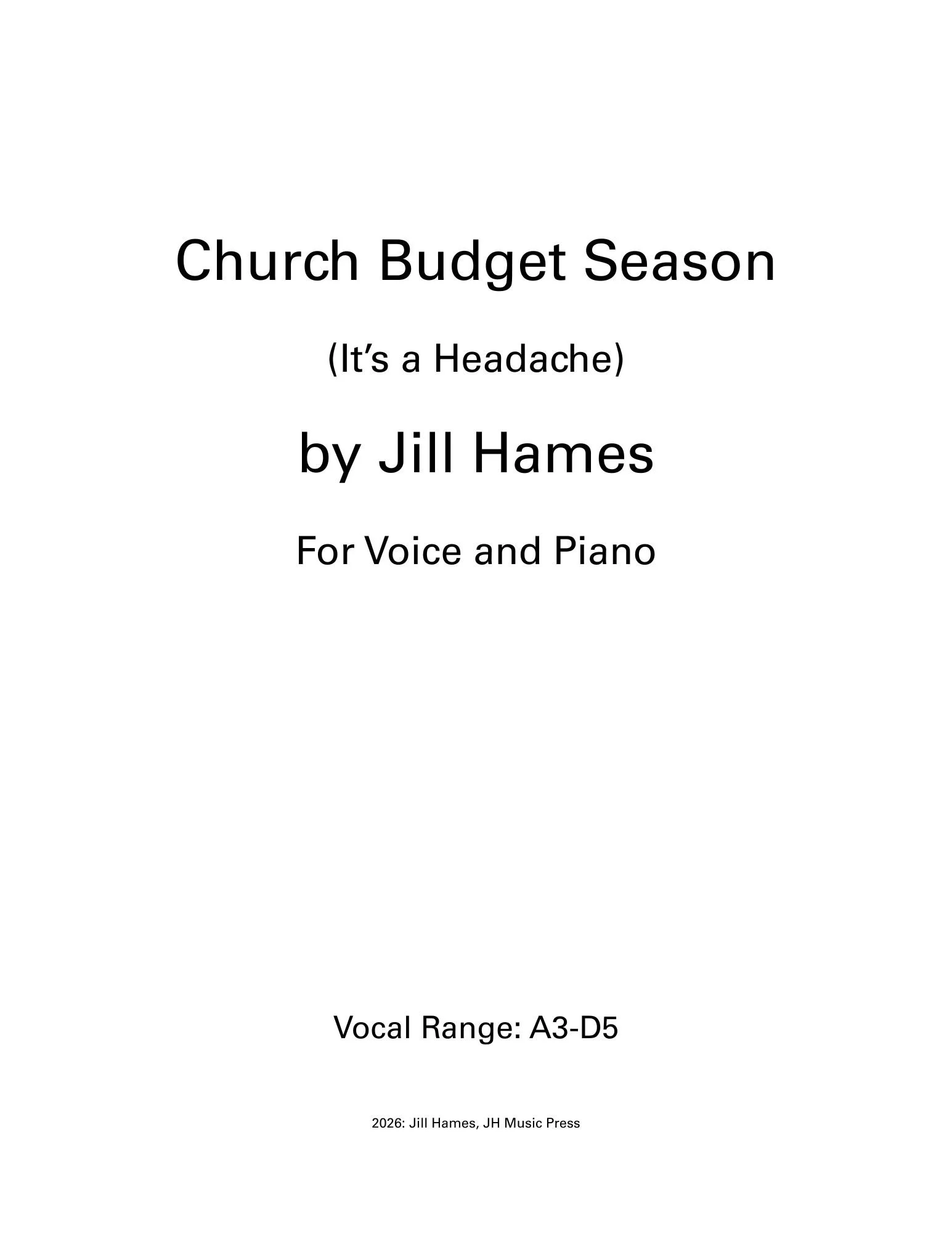
"Church Budget Season" is a humorous song from the perspective of clergy who dread working on the annual budget.
For Voice and Piano
Key: D Major
Vocal Range: A3-D5
Time: 00:02:00
Pages in Score: 1
Themes: Christianity, Church Seasons, Emotions, Protest, Humor
PDF Printable Download
This is a digital product, so I can't issue a refund. If you experience a problem, please let me know and I'll do my best to make it right.
This title is also available at JW Pepper and SheetMusicPlus.