
What we do changes our understanding
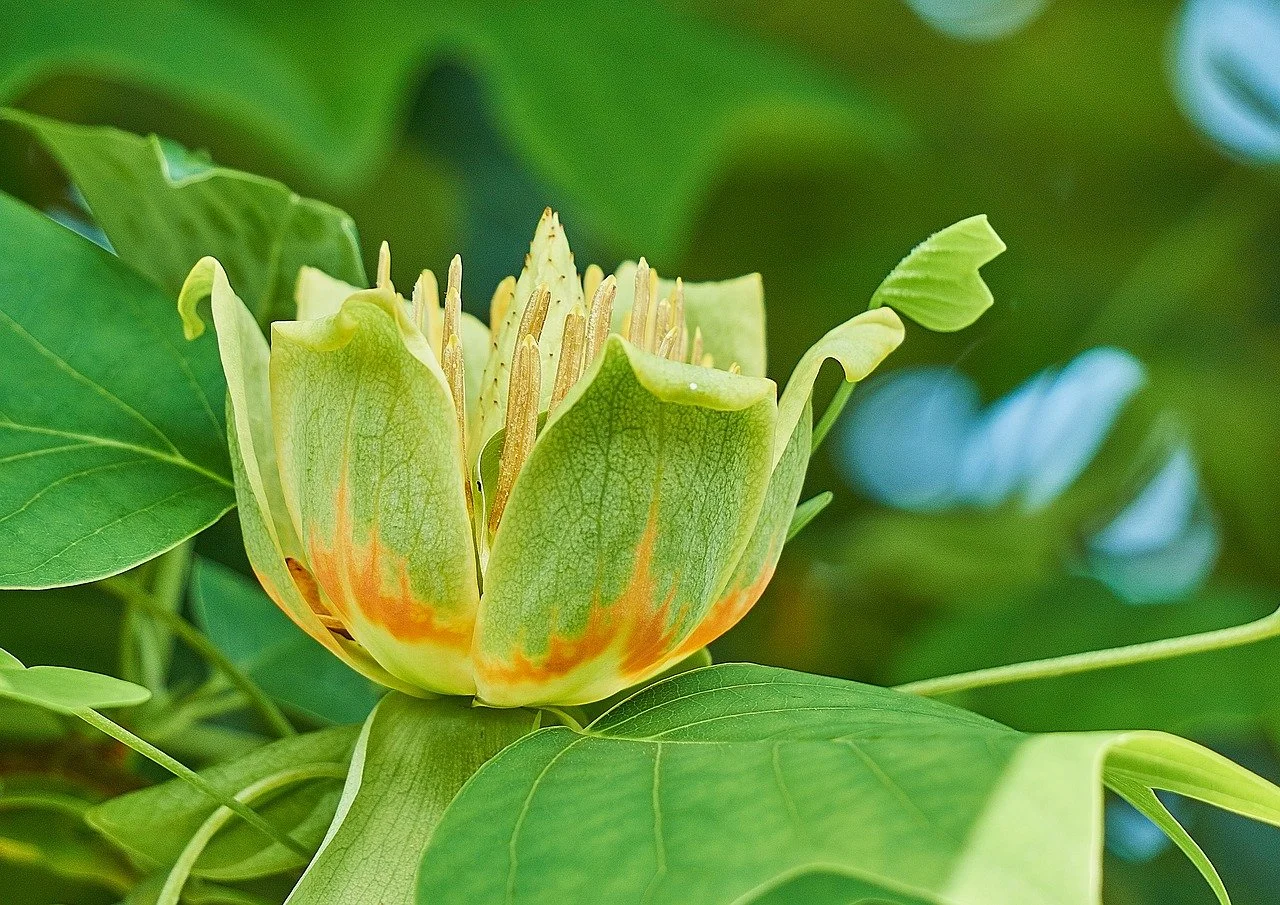
Tulip Tree Flower (Liriodendron Tulipifera); Photo by: Arkin54; Tagged: Public Domain; Source: NeedPix
CEFR Level C1-C2
I grew up thinking I didn’t like science because it was so amorphous. There were no rules! Nothing concrete to hold on to! (I’ve since realized the way you are taught has a lot to do with how you think of a subject.) Then, as an adult, I heard that there is a scientific discipline where people record the date the leaf buds emerge, the summer tanager arrives, and the maple leaves turn red. Basically, you can intentionally observe nature and compare one year to the next and be doing science. It’s called phenology. The phenologists use data and statistics to do sciency math things. That’s more than I have the education to understand. I developed my word skills more than my math skills. Still, I notice when the leaves turn later than usual or that the mountain mint stopped blooming sooner than last year. Turns out, that’s science.
A few years ago, I started observing for Nature’s Notebook (USA National Phenology Network). I selected a few trees in my backyard and 1-3 times a week record what I see. How much of the canopy space is full of leaves? Are there fruits or seeds? If so, how many are ripe? There’s a whole list of questions that turn my natural noticing into data for phenologists. Learning about phenology changed my identity from someone who didn’t enjoy science to someone who is excited to talk about at least one scientific speciality. I still think it’s an exaggeration to call myself a citizen scientist for notating when I see the first spot of yellow on a maple leaf, but “citizen science” is the term for volunteers collecting data that professional scientists use.
It feels weird to attach the description “scientist” to myself, no matter how caveated or modified.
I earn a commission if you purchase through The Vareity Page Reads.
The first year I observed for Nature’s Notebook, my data wasn’t as accurate as it could have been. I started by looking out my 2nd-story window to see the tulip tree canopy. I didn’t realize until several months later that most of the cones are in the top third of the tree, higher than I could see from my window.
Then I started standing at the edge of my front yard and using binoculars to see the tops of the trees. There were so many more cones than I first thought! Perhaps hundreds! Except, the way you count a lot of cones is to divide the tree into quarters, count everything you can see in a quarter, then multiply. The problem is, with binoculars, you can’t see a full quarter of the tree. I’m in year three and I’ve finally found a method that I can use consistently. What I learned is that consistency in method is more important than absolute accuracy.
Then there’s the light. I was taking my observations at the same time of morning each day. You know what happens to the light as the year progresses? The amount and angle changes. What might be brightly lit at 8:00 a.m. in June is covered in shadows at 8:00 a.m. in October. I had to adapt when I observe to the season.
This spring, mortifyingly, I realized that I had swapped two specimens of the same species. What started out as Tulip Tree 1 was being assigned data from Tulip Tree 2. I don’t know when the swap happened. I emailed the Nature’s Notebook contact and she assured me that these things happen and to move forward with the correction.
That should have been reassuring, but Tulip Tree 2 definitely follows a different pattern than Tulip Tree 1. To make myself feel better, I skipped a whole month when little was changing and then started again with the correct data assigned to the correct tree.
Through these three years of observation, I’ve noticed that I notice more. The act of intentionally looking has made me see even when I’m not observing. Just today, I exclaimed, “How interesting!” And then I understood what my brain had noticed. The sugar maple slightly up the slope is 25-49% yellow, compared to five days ago when it was less than 5% yellow. The sugar maple down the slope, the one I observe for Nature’s Notebook, is 5-24% yellow, when five days ago it, too, had less than 5% colored leaves. These trees are only about 10 strides apart, yet they are so different!
The Spiritual Connection
My education convinced me that science was boring and lacked rules. “Boring” is an emotion. There are too many factors creating emotions for me to comment on that. “Lacked rules” is a judgement statement. It also happens to be wrong, but I didn’t realize that until decades later when I had had many experiences that intertwined with and slid alongside science but weren’t specifically Science Education.
What beliefs might we have about Christianity that are consistent with our understanding of our experiences, but are ultimately false?
I came to understand science differently by reading widely and having hobbies outside of my main interests. Even though I didn’t read or listen to scientific things specifically, over many years, I realized that I no longer thought science was amorphous and unknowable. I can’t point to all the bits and pieces that led to this change of mind. Yet somehow, without actively engaging in the study or practice of science, my beliefs about it changed.
This could be applied to faith formation, too. What would happen if, instead of fervently reading all the approved books and listening to the most popular speakers, we instead read and listened broadly. What if we treated faith formation as a grand expedition with no return date rather than frantically trying to learn The Answers as if any day might bring a pop quiz that could ruin our life? Maybe after ten years of joyful exploration, we’ll be shivering in the sunset breeze and realize a theology has changed.
On the other hand, this exploration could be intentional, but I still don’t recommend fearing a pop quiz every day. I don’t think the biblical story as a whole shows God as a psychotic trickster just waiting to fail us. But what would happen if we intentionally read/listened broadly?
What might we learn about God from learning about spiders that only live in alvars from an old episode of Grubbing in the Filth? What if we listened to an interview from an author in a part of Christianity we were warned away from or that we give a Southern “bless their heart” to? What if we read 15th-century sermons followed by a modern history of women in the middle ages followed by a middle-grade novel about a daughter and single mom? What questions might float in our minds, still there as we read the Bible and pray?
None of this has to be hard work or forcing a spiritual meaning onto things. It’s just living life and letting life change us. I’m a reader and listen to podcasts, so that’s my reference point. Maybe you watch movies and are part of a kayak club. How has your understanding of life changed because of your experiences on the water? How has that understanding worked in the background to affect your faith?
It doesn’t feel right to call myself a citizen scientist. I’m not a scientist. I’m an artist. I don’t do math or experiment with chemicals. I write, compose, and make things. Yet, the volunteers who enter data into Nature’s Notebook are called citizen scientists. That means I am called a citizen scientist.
What label within Christianity doesn’t feel right for you, but you are what the label is defined as?
What does it mean to accept that label as part of your identity? What part of your identity has to change in order to accept the label?
What is the personal and social cost of using a label for yourself that others would use?
What identifier does God use for you? How do you know? What would it mean for you to use that label for yourself?
How do you know the difference between what God calls you and what Christians or the church calls you?
When I looked out my window, I missed what was happening in the tops of the trees. When I stuck to a schedule, the light prevented me from seeing, no matter how hard I tried.
How might your environment affect what you believe exists within Christianity?
How might your spiritual disciplines be inhibiting your ability to understand how to live as a Christian?
I accidentally swapped the data for two trees. I made a mistake and was embarrassed. To the people who I was trying to help, the mistake wasn’t nearly as serious.
What error might be making you want to give up, but might be less serious than you thought if you talked to the people affected?
Even if it is as serious as you thought, they are the best person to tell you how to move forward in a way that limits the effects of the error. (Of course, there are limits to this. If abuse is involved, this article doesn’t apply. There may be other cases, too. Take the principle, but use your judgement on when to apply it.)
Finally, in my third year of observation, I notice things without trying. Before, I might have noticed that the maple leaves are changing. Now, I notice that the sugar maple leaves are changing by a percentage group and the difference between two trees.
How has the way you notice, think, or act changed after years of slow, persistent faith practice?
Conclusion
Discovering phenology taught me that I had formed erroneous conclusions based on my science education. Practicing phenology has enriched a casual lifestyle habit.
What might be waiting within Christianity for your discovery?
How has a past discovery enhanced your faith?
"Because of You" is an emotional song expressing how a relationship doesn't have to be perfect before it can be good and beautiful.
For Voice and Piano
Key: B Minor Vocal
Range: G3-F#5
Time: 00:02:00
Pages in Score: 2
PDF Download
This is a digital product, so I can't issue a refund. If you experience a problem, please let me know.
This title is also available at JW Pepper and SheetMusicPlus.