
Caring for Yourself Honors God
Who turned caring for God’s creation into a sin?
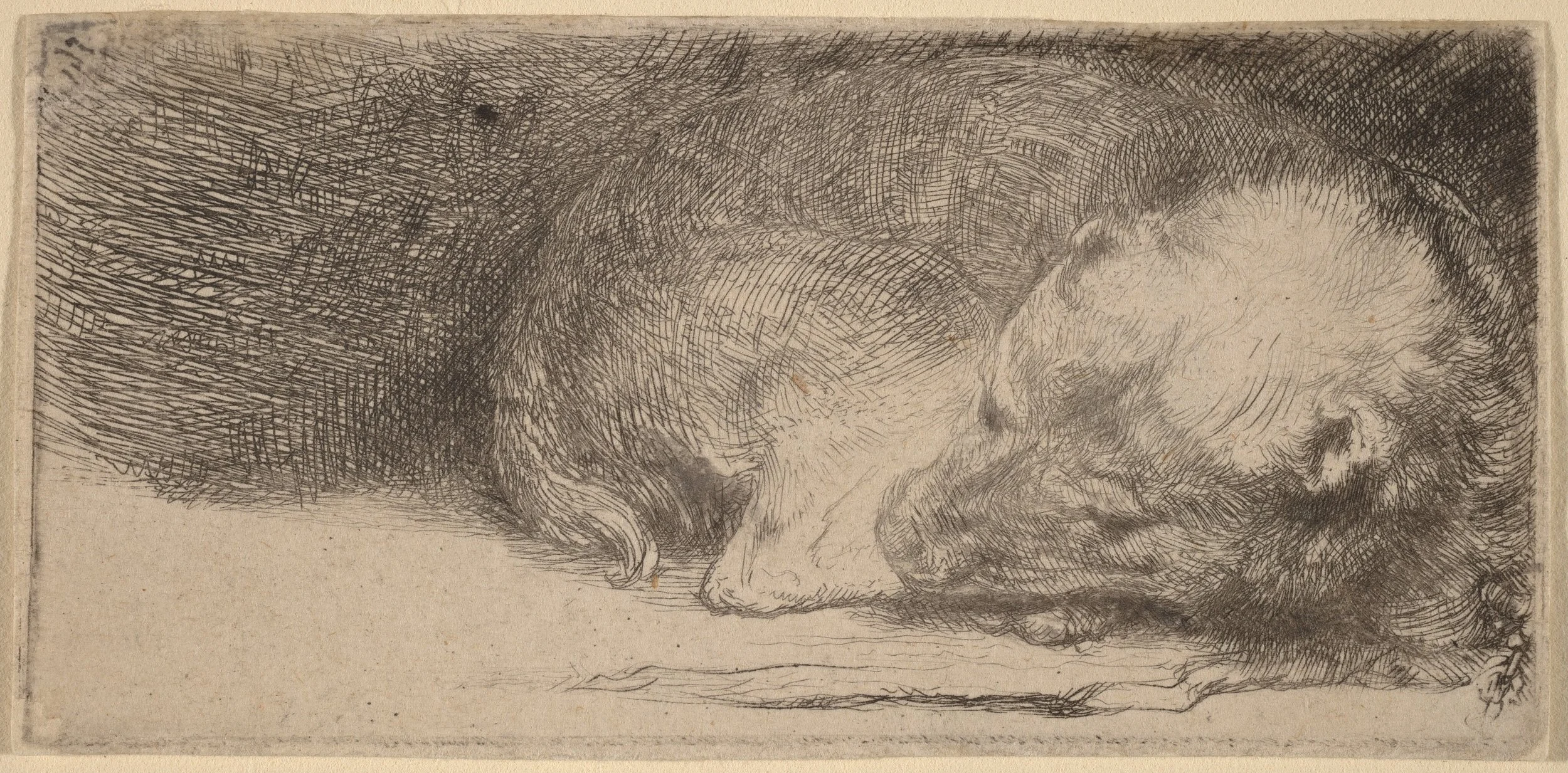
Sleeping Puppy; c. 1640; Rembrandt van Rijn; Source: National Gallery of Art
CEFR Level B2-C1
“Thank God I didn’t go to church in my most formative years!” I often have this thought when I hear/read something from a Christian speaker/writer.
One of those times happened while reading “In Defense of Self-Care” by Leanna K. Fuller (Journal of Pastoral Theology, 28. 1, 5-21, 2018). According to Fuller, and other content I’ve encountered over the years, many Christians believe that self-care is sinful because it focuses on the self.
I am flabbergasted. If we believe the Genesis creation account, God created humans and called them good. I can see at least three possibilities:
Those good humans didn’t need sleep, food, social interaction, intellectual fulfillment, time alone, and so on
God said the human was good but the needs God put in the human are not
God said that it was good that humans need those things.
That third option seems the most likely.
Can self-care be done to excess and to the detriment of self and others? Sure. But that is a different question from whether or not self-care in and of itself is wrong. If we claim that self-care is itself wrong, then we are saying that Jesus did wrong (or in religious language, that Jesus sinned).
Here are a few examples of Jesus caring for himself.
Jesus took time to eat.
Mark 2:15 is one example. Jesus is having dinner at Levi’s house. There is no explanation for why. The simplest explanation is that humans need to eat, so when it was dinner time, Jesus ate. If Jesus took breaks for meals, why should a Christian think it is more holy to skip meals in favor of ministry work? It’s not like Jesus healed all the sick people in a town, convinced everyone he was the Messiah, then sat down to dinner. He stopped and ate while much work was left to be done. It’s possible someone he could have healed died while he was eating. We shouldn’t expect more from ourselves or our ministers than Jesus expected from himself.
It could be argued that Jesus was doing ministry because he had just called Levi to become his disciple. It could be argued that eating was his way in to minister to a group - that the point wasn’t eating, but ministering.1 I don’t think there is strong support for that. It can be both. Plus, the text doesn’t show Jesus doing overt ministry until someone objected about his choice of dinner companions. It shows Jesus eating with someone who accepted him. It’s possible that all Jesus wanted was dinner with people who weren’t going to challenge him at every turn but then his opponents forced him into overt ministry.
Jesus sometimes put a boundary between himself and those who wanted his help.
In Mark 3:9-10 we read that Jesus got into a boat because people kept wanting to touch him so that they would be healed. By putting water and a boat hull between himself and the crowd, Jesus prevented people from touching him. Presumably, this meant that some people didn’t get the healing they hoped for. Even if it doesn’t, the fact remains that Jesus needed space after having people constantly touching him. This reminds me of how parents, especially mothers, of young children will say that by the end of the day, they just need some time without someone touching them. We could say that Jesus gave us precedent for taking a break from our body being used for physical comfort.
Jesus took time with just his closest friends.
Mark 6:31-32 tells us that Jesus and his disciples were so busy that they didn’t even have a chance to eat. Jesus eventually put a stop to that by taking his disciples away to a place where no one was (“a solitary place”). That plan didn’t last long since the crowds followed, but the principle remains that Jesus and his disciples were hungry and overworked and Jesus stopped the ministry work so that they could recover. The fact that crowds took the time to find out where they went and then followed them means that the ministry work was stopped while there was still need. When we say that we can’t take a break to care for ourselves because there is still work to be done, we are in contradiction to how Jesus acted.
I earn a commission if you purchase through The Vareity Page Reads.
What about the people who tried to help themselves?
Jesus healed people who asked for it.
Asking for what you need is part of self-care. Think about all the stories of lepers and blind people sitting next to the road and calling for help. Jesus never scolded them for taking care of themselves. He never told them they were in sin for taking time out of earning a living to find themselves help. He didn’t say that only if a family member dragged them to see him as they protested all the way were they deserving of help. They asked the person they perceived as able to help for what they needed and Jesus gave it.
Why do we think that Jesus will be mad at us for asking the person we think can help to help us? If we truly believe that Christians are God’s hands and feet, then why do Christians think it is sinful to ask other humans for help for themselves?
This whole idea of relying on God by not asking humans for help saddens me to no end. Humans are God’s first responders. From the very beginning, humans were put in the Garden to care for creation. Why do we think that as Christians we no longer qualify for the care God offers to creation through humans? What twisted logic have we accepted that makes us believe that we can be caregiving representatives of God but we cannot benefit from our own caregiving abilities?
Part of caregiving for others is getting them to the people who can help them. Why have Christians decided it is wrong to care for ourselves in the same way?
What about hobbies and just-for-fun?
I don’t see biblical texts addressing hobbies and just-for-fun activities like manicures and video games. What I do see in the Old Testament is appreciation for craft. In Exodus 35, Moses calls for skilled persons to come help make the tabernacle. The description of the tabernacle is more than functional. It is beautiful. Engraving, weaving, embroidery, and all the skills used to make the tabernacle beautiful require practice. Just because God gave the workers skill doesn’t mean they didn’t have to develop that skill. Developing a skill takes time, repetition, even what we might call wasting materials.
Skills of creation and making things beautiful might not be considered productive tasks in modern times, but I wonder if the same gift of skill is still given to people. I wonder if God gifts us with the ability to make beautiful things, if the act of creation is itself soul-restoring, and then we turn around and call using this gift a selfish waste of time.
As for other forms of relaxation, like video games and manicures, I can’t think of a biblical event that would relate. I think the question becomes one of purpose and outcome. Are you participating as a way to avoid your responsibilities with detrimental results to yourself and others or are you setting aside responsibility for a short time in order to be more effective when you return with the outcome that the people you serve get the best of you?
There Could Be More
If we start asking why Jesus did certain things and push ourselves to imagine beyond the known answer, more possibilities arise. I’m not saying to take those possibilities as proven biblical truth, but I think they can be useful to think about and to ask “what would it mean if this were true.”
For example, at the end of Matthew 8, an entire town rejects Jesus. What does Jesus do? Matthew 9 suggests that he went home for a visit. Was this because that was always the next stop, because it was convenient, because he felt rejected and wanted the comforts of home, or something else?
What if Jesus felt so sad and tired from being rejected for helping someone that he just wanted to go home and hug his mamma? What would that mean for us and how we care for ourselves?
Once you start wondering why Jesus did something, he becomes a lot more human than when we settle for assigning plans and spiritual disciplines to his actions. Plans and disciplines can be true and also it can be true that there may be more if we allow Jesus to be as much human as we venerate him as God.
Now, I suppose that it could be argued that it is good for humans to need food, rest, intellectual and emotional fulfillment, and so on, but that it is sinful for the human to attempt to provide those things for themselves. Under that logic, a person who works for the paycheck that pays for food the family eats should not eat that food, but rather go to another person’s house to eat their food. The person who makes the food should not eat it, but only eat what another prepared for them. In any iteration, it’s just silliness.
If even part of the argument were valid, then we would need to figure out under what conditions it is good for a person to provide for themselves and when it becomes sinful care of self. Those sort of line-drawing debates remind me of Purity Culture arguing over if holding hands is as intimate as intercourse or the Pharisees being threatened when Jesus healed on the Sabbath because he ran past where they defined not working.
Conclusion
What I hope I have done here is to encourage you that Jesus doesn’t expect you to run yourself ragged or be miserable. In fact, I believe that Jesus is happy when you take time to care for his creation - you! After all, Jesus himself took time to care for himself. As a Christian, what better example could we follow than Jesus?