
Book Review: Simply Good News
CEFR Level B2-C1
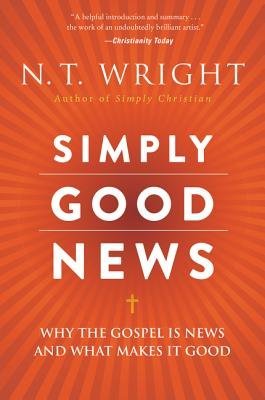
“What is the good news that Jesus himself announced and told his followers to announce as well (2)?” This question frames the purpose of the entire book and Wright takes readers along as he works through the question in the context of 21st-century Western Christianity. Appropriately, Wright does not use the modern context of the discussion to inform the answer. Rather, he answers the objections and questions he anticipates people living in 21st-century Western Christianity may have, using Jesus’ context when defining what the good news is. This historical context is what Wright calls the “backstory,” proposing that we cannot understand the good news if we do not understand the backstory (3).
Chapter 1 is all about defining “news,” particularly as distinct from advice and in the context of the 1st-century Roman Empire. Under both perspectives, “news” is something that has already happened which has an effect on the future, which influences how life is lived right now (12-13). Wright uses Chapter 2 to address the confusion that definition may cause readers who think of Christianity as a religion, philosophy, or moral code (16). In the process, he explains how Christianity was, and still can be, seen as silly, offensive, or life-altering. What makes Christianity news rather than a moral system is that Jesus came back to life after being dead (18). That turns the Christian message from being one of numerous suggestions to follow this or that god or philosophy and into an announcement of an event that changes things forever (19).
Christian news is not just that Jesus came alive again. Chapter 3 shows that it was also what Jesus came to announce (39), although many original recipients of the news were disappointed. Some Jews wanted to hear news of a military king who would make things like they were when Israel was an independent, thriving nation (38). Others were disappointed that his news contradicted the common advice to live a pious life either removed from, or quietly in, society (39). People wanted advice and Jesus gave them news that the fundamental nature of reality had changed (43).
That is confusing, and anyway, how do we know those ancient texts that claim to record Jesus’ news recorded the truth? Chapter 4 tackles that question and the false gospels that come out of Jesus’ life being news. This includes claiming that “the whole point of Jesus’ good news is that the one true God is not a tyrant” (63) and that “it is paganism that imagines a malevolent, irascible deity determined to take out his wrath on someone and eventually doing so on the one victim who didn’t deserve it” (74).
After leaving the reader questioning everything they thought they knew about Christianity, Wright uses Chapter 5 to ask them to rethink their conception of heaven. In his words, “To say ‘Jesus died for your sins’ ought to lead at once to ‘so you can freely pick up your role as a truly human being and discover your particular vocation within God’s purposes for his world’” (99). If that were not confrontational enough, Wright concludes the chapter by suggesting that heaven began forming with Jesus (101). This is not a chapter for those hoping for an expectation-free life now followed by a happily-ever-ever in a far-off mystical heaven.
Fortunately, Wright does not leave the reader fumbling for how to describe heaven if it is no longer the happy picnic ground over the rainbow. Chapter 6 explores more of what it means for heaven to be a renewal of this physical earth and how Christianity came to understand heaven as an over-there place separated from down-here Earth. All this could leave the reader reeling, but Wright gives a relatable analogy on page 111. He explains how scientists make discoveries, but the average person may not hear about it unless someone chooses to believe it. Even then, the discovery may not catch on in popular opinion unless it is something that people want to believe. Using this analogy, Chapter 6 helps to explain how popular ideas about heaven came to be popular, regardless of their origins or biblical support.
Having upended the reader’s notions about the good news and heaven, Wright takes on ideas about God. Chapter 7 summarizes philosophical and historical movements in Western thought that influenced how Christians think about God. Turns out, modern conceptions of God are influenced by secular thought, such as Deism (130) and the human desire to make things easy to understand (148). The chapter ends with news that doubles as a call to action: The trinitarian God “calls to [people] with sovereign love and summons them to join in his work of new creation” (150).
Supposing a reader may want to respond to this news with action, Wright uses Chapter 8 to suggest prayer. Wright does not suggest just any prayer, though. He suggests using the Lord’s Prayer as a template in a very specific way. Using the analogy of a guest going to a new friend’s house for the first time, Wright does not scold people for coming in the back door of prayer. He does, however, suggest that the front door may be a better experience and explains how to do that in prayer. Fortunately, this chapter is more about a concept than a rule preaching that if you do not pray in a certain order, then you are doing something wrong. As Wright says, “[I]f you're in, you’re in” (156). In other words, praying is better than not praying. Still, the chapter, and the book, ends with Wright commenting that if we do not pray “shaped the way the Lord’s Prayer is shaped,” then we run the risk of praying for our own ideas of how the news should happen rather than praying for God’s good news to continue (171). If that sounds like a rule destined to produce religious scrupulosity, his conclusion reassures readers that Christian prayer is useful, encouraging readers that “[i]n prayer, we learn to become good news” (171).