
Good and Bad Fruit
Is it the tree, the fruit, or both?
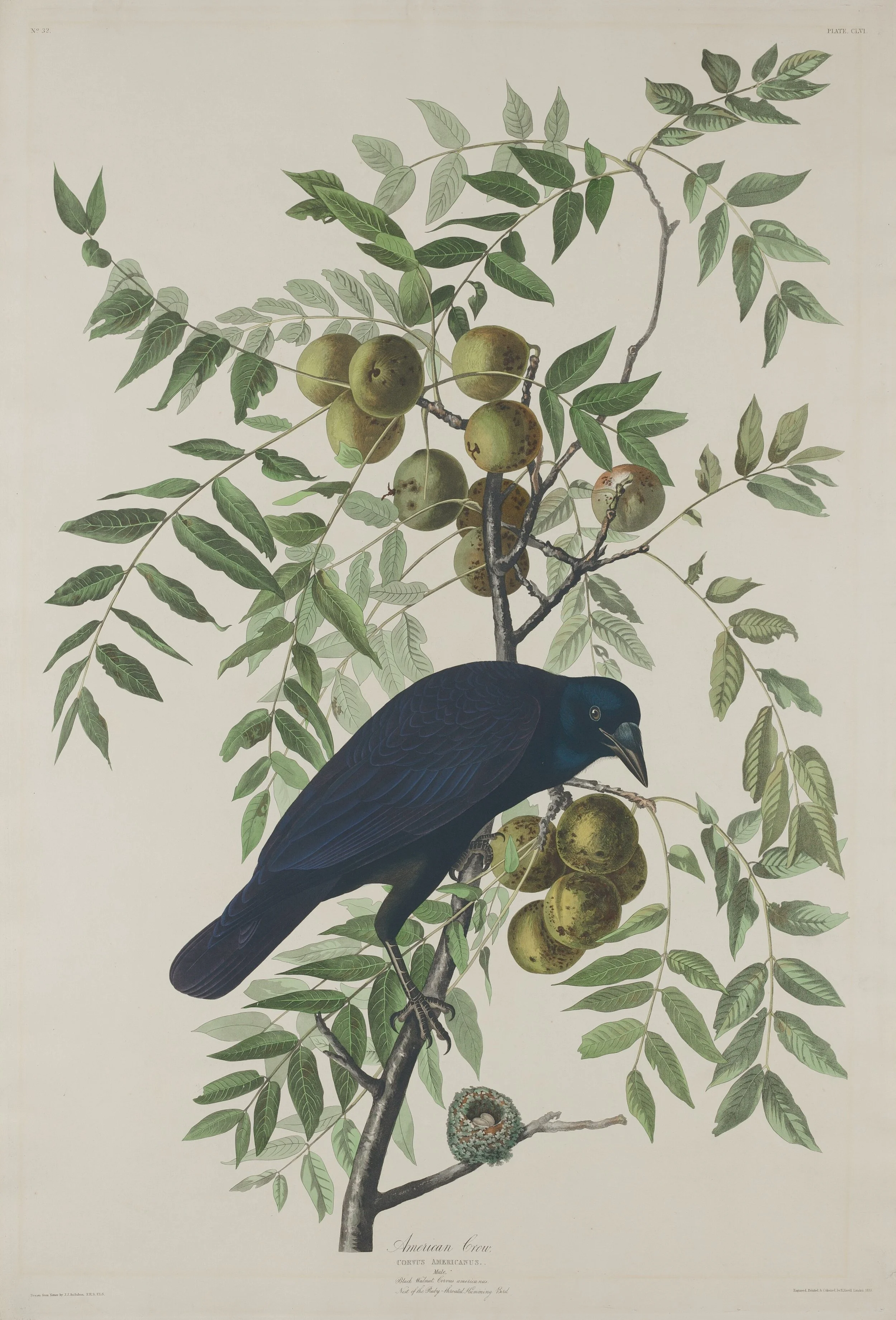
American Crow; 1833; Robert Havell after John James Audubon; Source: National Gallery of Art
CEFR Level B2-C1
Background
I recently finished reading the entire Bible. For 30 years, I’ve steadily read the entire Bible, then started again. It takes me 3-6 years for one round. Considering how many people - embarrassingly ministers included - who I have heard say that they have never read the entire Bible, I advocate for slow and steady progress with the expectation of missed days rather than Bible-in-a-year programs.
My reading doesn’t follow one plan. I have read Genesis to Revelation. I have read roughly chronologically. I have read alternating Old Testament and New Testament days. I prefer the last one, with Psalms and Proverbs sprinkled in. Reading straight through Psalms and Proverbs, for me, is almost as much a slog as the genealogies. I know that lectionaries follow a NT, OT, Psalm mix, but whenever I’ve looked at a lectionary schedule, everything seems so disjointed. I feel anxious when I think about trusting someone else’s decision at where to start and stop a section. At this point, I don’t even pay attention to the headings in my Bible, other than when scanning to find a pericope (short story or passage). Instead, I stop reading where the thought seems to end. I know that’s the point of the headings, but they don’t always make sense to me. Plus, I think reading through them helps me to see how Thought 2 is influenced by Thought 1. That can be harder to do when reading in pre-determined segments.
I almost cut that intro since this essay isn’t actually about how to read the Bible. I decided to leave it in
To encourage people to read the entire Bible.
To give people an option to the guilt and boredom of trying to read long sections of ancient text each day.
Matthew 7:15-20
As I said, I recently finished reading the entire Bible and was deciding where to start: chronologically, NT/OT, lectionary. I felt drawn to the Gospels, so I started with Matthew. About that time, my husband was talking to me about the good and bad fruit passage. To paraphrase in his style: A good tree can’t bear bad fruit; no way!
I had to think about his assertion agriculturally and metaphorically. I could see his point, but I also had the sense that something was missing. Even if a pear tree is generally healthy, fungus can still infect the fruit. On the other hand, I have not experienced or heard of an infected tree producing good fruit. Then again, I’ve never tended fruit trees. My knowledge comes from chatting with “the fruit man” at the farmers’ market. Yet again, if the pear is good until fungus infects it, did the tree technically produce good fruit? I began to wonder if I was overthinking things, but the metaphor relies on understanding the agriculture.
The conversation faded into memory until a few days later when I read Matthew 7:15-20. This is one of Jesus’ “good trees make good fruit” comments. Somehow, I had always thought that “bad fruit” meant good fruit that was infected, or metaphorically, a Christian who started doing things that Christians were forbidden from doing. It also hadn’t stuck in my memory that Jesus’ comments are in a section teaching the average person how to evaluate a person with a title that would make people trust them as religious leaders. I’ve only heard sermons on this passage make the application be about the works or belief of the average Christian. Reading the passage this time, I wondered if “bad” means “contrary to nature.” Green briars don’t grow grapes. Grape vines can’t produce poison ivy berries. Sweetgum trees don’t grow chestnuts.
From this perspective good and bad fruit are representative of the innate nature of the plant. The theological term for that concept is “ontology.” The ontological nature of a grape vine is to produce grapes. It is against the ontology of a sweetgum tree to grow chestnuts.
Applied to humans, we can go deep into a maze of propositions and arguments, trying to decide if humans are innately (i.e. ontologically) good (or evil). That question hasn’t been settled for 2,000 years, so while it is worth thinking about and the conclusion you come to has serious implications that cascade into every area of life, I don’t think its discussion is necessary to understand Jesus’ metaphor. If it were, I think Jesus or one of the Gospel writers or editors would have included a section addressing it.
Let’s keep things relatively simple. The “good fruit” metaphor implies that if someone offers you red poison ivy berries and tells you they are tiny cherries, it doesn’t matter how convincing or kind they are. They are wrong and you’ll most likely become seriously ill. That fact is the important part, not the part where they were kind when they offered the fruit.
Exploring implications, if the person made an honest mistake through a gap in their own education (AKA a fungus got in their fruit), then a “good tree” would apologize to you and stop recommending fruit. If they wanted to keep on helping people with fruit ID, they would stop while they spent intentional time studying and checking their knowledge against others’ knowledge before again trying to assist others with fruit ID. The character, the nature, of a “good tree” person is one of humility, righteousness/justice, kindness, self-control, and love.
A “bad tree” would insist that they are right because they have studied or that anyone can make a mistake, so no one should be surprised when a few people get hurt. A “bad tree” might blame the person who ate the fruit, saying that they should have done their own ID before taking the guide’s word for it. A “bad tree” would not admit they did anything wrong. They might stop saying that poison ivy berries are cherries, but at the same time they might be so convinced that they are right and the person who got sick just had a special response that they keep on giving people poisoned berries. The character of a “bad tree” is arrogance, scorn, unkindness, dismissiveness, deceit, and self-aggrandizement.
It’s worth noting that if the person offering fruit claims to be skilled at identifying fruit, lists credentials that back up those claims, and gives off “good tree” vibes, you don’t have a reason to be cautious. If someone got sick from eating poison ivy berries because they were told they are cherries, most people would think the recommender needed to stop giving people fruit, either forever or until they had improved their identification skills under close supervision. If they didn’t stop, we would think them reckless. It’s curious how many Christians have lower standards for those who offer spiritual food than we do for those who offer physical food. To me, this suggests that those Christians place a low value on spiritual matters, their protestations to the contrary notwithstanding. Without using words, they are saying that the spiritual life doesn’t really matter, so if someone is harmed there, overall, they’ll be fine, therefore the harm isn’t that important - after all, it’s just a spiritual matter, so all you need is God.
Matthew 12:33-3
A few days later, I read Matthew 12:33-37. It occurred to me that verse 33 implies that humans can make a tree good or bad, which leads to good or bad fruit. In other words, if you leave the tree without tending it, over time the apples may become smaller, fewer, harder, and more sour.
The rest of the section is about what we say. Whenever I have heard this passage preached on, it sounded like the main point was to caution Christians to be careful about not accidentally letting an annoyed response slip out when someone has asked you the same question four times (and you’ve given the same answer each time), not accidentally saying “no” to a question when you mean “yes,” not using interjections (e.g. Oh, shoot!), and other forms of unpolished human communication that are useful and benign. Growing up, I was an anxious, shame-filled person because of that teaching.
Reading the passage this time, I wondered if verse 36 is less about the carelessness or thoughtlessness that comes from being human. I wonder if the point is that words matter, so, for example, calling demeaning language a joke is a careless use of joking. If the demeaning language happens in a sermon, then it is a careless use of words that are meant to do good and not evil.
Under this understanding of the passage, claiming that the only reason the words caused harm was because the listener applied the message the wrong way could also be considered careless. Such a claim is a defense, not words uttered out of kindness, gentleness, self-control and a desire to live righteously. I’m talking about spontaneous claims. In these cases, the careless words indicate a bad tree that is producing bad fruit. In cases where the speaker has had time to think about how to respond, I would not classify the response as careless, although the person is still demonstrating that their character/tree is bad, perhaps even more so than the person who spoke carelessly.
Matthew 12:33-37 is part of a longer teaching Jesus gives in which he opposes the established religious leaders. They dismiss his miracles of healing as evil and he responds that careless words matter.
The text doesn’t explain why, but I can imagine a devout Jew being curious about Jesus’ teachings. Then this devout person hears the religious leaders condemn the healings and other miracles as acts of evil. The devout person, trusting the religious leaders, avoids Jesus. This would make the religious leaders happy, but as Christians we would be saddened if someone were taught to avoid Jesus.
Conclusion
Taken together, these two fruit tree passages suggest, among other things:
Character matters.
Fruit is known as good or bad based on how it affects people.
People with religious power have been warned to carefully consider the effect of their words.

Six 2-hour lesson plans to prepare a team to go on a vision or missions trip. Includes facilitator’s notes, suggested resources, and participant handouts. Participant handouts are limited to 12 copies. Please contact Jill Hames if you need more.
Please note: This is not a plug-and-play curriculum. These lesson plans assume the facilitator has background knowledge in the topics. Please see the syllabus and facilitator requirements below. You may also contact Jill Hames about scheduling a synchronous or in-person class with your group.
Leader Background
This training course is primarily designed for groups going on vision trips, as distinct from missions trips. Because of this, leaders are expected to be more knowledgeable than may be expected from leaders whose primary job is to wrangle a group and manage logistics.
This course could also be led by an outside facilitator to train leaders who will then form and train teams.
To lead a vision trip, the leader should have:
Familiarity with the different types of vision trips and understand the difference between vision trips and missions trips
Familiarity with intentional conversation techniques (e.g. Asset Based Community Development listening conversations) and ways to formulate useful questions
Personal experience in the host country
Personal contact with leaders at the host church(es)
Syllabus
Session 1: Why a Vision Trip?
Discover what we already know, or think we know, about the host country
Explore data that may challenge our assumptions about our country compared to theirs
Consider the difference between Christian mission and missions
Learn the difference between a vision trip and a missions trip
Plan for food and money needs on the trip
Session 2: Cultural Intelligence, Part 1
Discover what we know about our culture
Explore how the same thing can mean something different in different cultures
Learn to talk about how we talk
Consider definitions of the Gospel
Plan for clothing needs on the trip
Session 3: Cultural Intelligence, Part 2
Discover what we “just know” and how that changes when we go to another culture
Learn about high and low context cultures
Explore indicators and practices of high and low context cultures
Consider challenges we may face in a high/low context culture
Plan for hygiene needs on the trip
Session 4: Support and Partnership
Discover how we understand the difference between support and partnership
Explore the difference between support and partnership in the context of churches in different countries
Learn about historical problems in Western missions work
Consider how historical problems may/may not influence missions work today
Plan for medical needs on the trip
Session 5: How to Ask Questions
Discover our metrics for rudeness and politeness
Explore context and other clues for how different cultures perceive the rudeness or politeness of different interactions and actions
Learn how to ask useful questions (The 5 Ws, Question Formulation Technique, etc.), including listening to understand
Consider how to summarize what has been learned in these five sessions for a full assembly of the sending church(es)
Plan for what the group will actually be doing (listening conversations, group-led project, host-church-led projects, etc.)
Session 6: Involving the Sending Church(es)
Short group presentations on what has been discovered, learned, and discussed over the past five sessions
Time for prayer and sending rituals
Remind all of the team’s purpose and the role the sending church(es) will have on their return
Enjoy a social meal between the team and the sending church(es)
Anticipated Outcomes
Participants will be able to explain the difference between a vision and a mission trip.
Participants will be able to discuss the difference between Christian mission and missions.
Participants will be able to identify the challenges in defining the Gospel as distinct from Christian practices and cultural ideals.
Participants will be able to identify and discuss context clues to help them decipher subverbal communication.
Participants will be able to identify aspects of high and low-context cultures.
Participants will be able to discuss the similarities and differences between support and partnership.
Participants will be able to identify and use methods for creating useful questions.
Participants will be able to present, in a group, to a group about what they have learned.
Participants will be able to succinctly state the purpose of the trip.
PDF Download
This is a digital product, so I can't issue a refund. If you experience a problem, please let me know.