
Book Review: The Cross and the Lynching Tree
With a suggested companion book
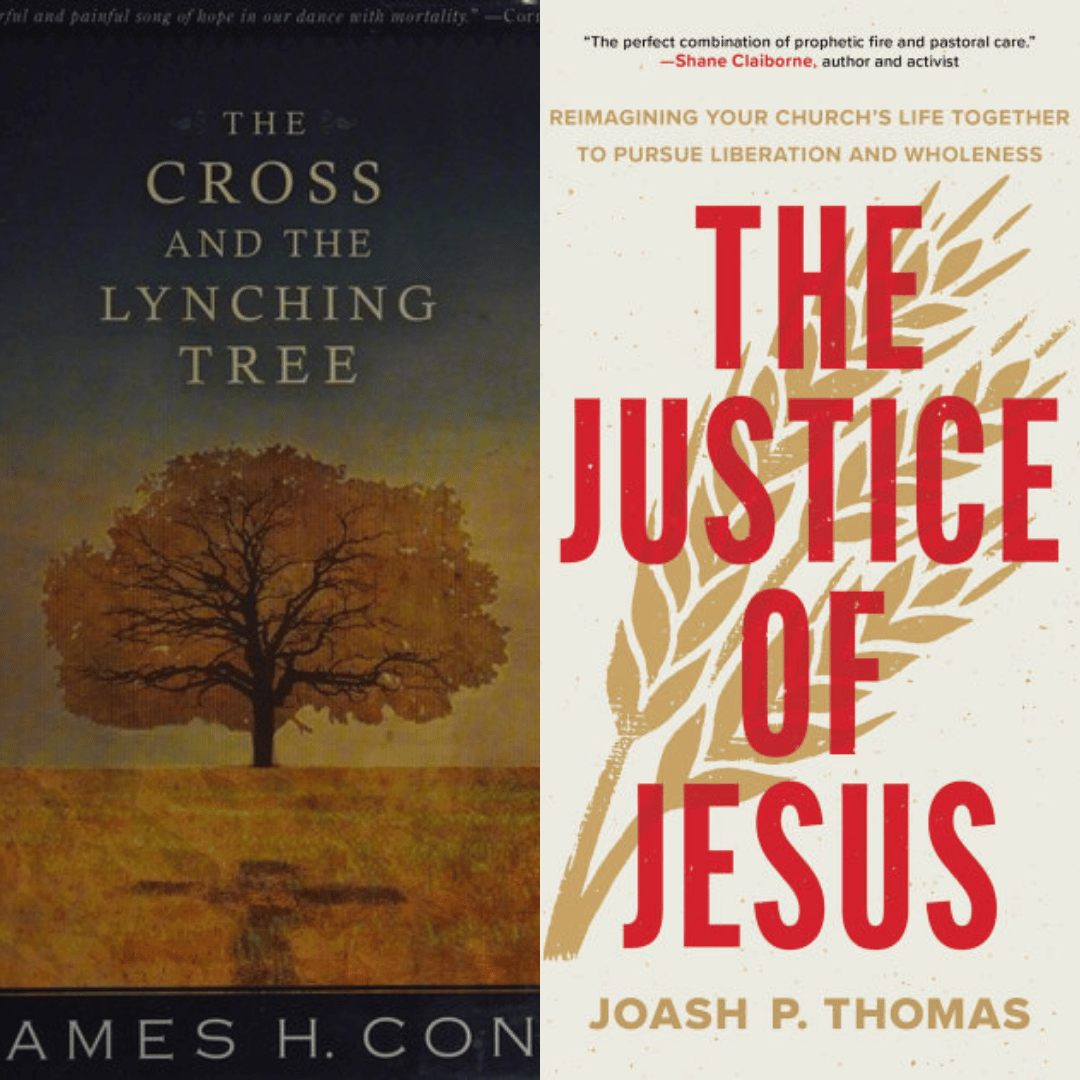
The Cross and the Lynching Tree
CEFR Level C1-C2
The Cross and the Lynching Tree by James Cone is an intense read at the beginning, especially if a reader has been taught to avoid saying anything that will make others uncomfortable or to use euphemisms or vague references if it is necessary to talk about such things.
Cone uses the word “lynching” because that is the correct term to use for his topic. He describes what lynching is because that is necessary in a society where the term has come to suggest only execution by hanging from a community mob. He describes what it is like to live in a society that uses torture as a social celebration, with an emphasis on the experiences of those who are the targets of the torture, because that is what is needed for an audience who is part of the celebrating group to understand the experiences of the targeted group. Despite being clear with his descriptions, Cone is not gratuitously graphic. To avoid these descriptions would be like a surgeon trying to explain a procedure to a patient without using the words “incision,” "surgery,” or “operation.”
In Chapter 2, Cone says, “There is no justice without power, and there is no power with one, two, or three tokens [of representation]” (61). In other words, if a church or denomination’s board has only one woman and one non-white person, then the minorities do not have power. That means they are unable to work as effectively for the benefit of those like them, compared to the effectiveness the majority has with working towards the benefit of those who are like them.
Even though Cone was a Black theologian, the intended audience of The Cross and the Lynching Tree is primarily white people in the US. In the Introduction, Cone proposes that if white Americans faced the reality of the terror they caused Black Americans, then they would better understand those who terrorize them (xix). Read from this perspective, the book becomes applicable to more than the reader’s theologies of race and history. That is to say, Cone’s application of liberation theology can be encouragement or challenge.
For example, in Chapter 3 Cone maintains that Dr. Martin Luther King, Jr. believed that doing work he was convinced God approved of was not enough to protect him from assassination (85). This is a contrast to the belief many Christians are taught - the belief that if a person is doing God’s will, then that person will be protected. For the person fighting against oppression, Cone’s presentation of Dr. King’s belief can become a defense against those who try to stop their fight by saying that if God approved, then the fighters would have already succeeded. For the person on the culturally superior side, even if they are not actively working to stop those fighting to be seen as fully human, Cone’s inclusion of Dr. King’s conviction can challenge them to evaluate the belief that success equals God’s approval.
For readers who have difficulty understanding this concept, Joash Thomas’ The Justice of Jesus would be a good companion book for The Cross and the Lynching Tree because Thomas’ book focuses on how representation, or lack thereof, affects outcomes. For readers who find Cone’s work too intimidating an entry point into Christian justice theology, Thomas’ book works through objections, concerns, and challenges common in white Western Christianity. For readers who finish Cone’s book wondering what action they can take, Thomas’ book gives practical suggestions ranging from prayer to budgeting to advocacy. To use Christian jargon, Cone speaks as a prophet and Thomas speaks as a pastor, allowing each book to expand on the other.
For ministers and other church workers whose faith was formed in the white Western church, The Cross and the Lynching Tree may help them understand the perspective of minorities, particularly Black Americans. If a minister has ever wondered why minorities seem to prefer their own churches, this book may help answer that question. For a church leader, particularly in the US South, wondering how to create interracial understanding among their predominantly white congregation, this book highlights challenging topics that are likely to hinder progress unless addressed, starting with accepting that much of white Christianity in the US has a history of presenting human oppression and torture as consistent with following Jesus and that this history still affects attitudes and actions.
Ultimately, The Cross and the Lynching Tree is a theological work written for the average reader who has an interest in theology or the relationship between beliefs and action. In the final chapter, Cone summarizes the connection between history and theology, explaining that understanding the history of the lynching tree keeps the message of the cross from becoming “sentimental piety” and the message of the cross keeps the history of the the lynching tree from taking away all hope (161). While it is clear that Cone hoped his book would incite action from those previously apathetic towards justice for Black Americans, he also practices what he preaches by avoiding spiritual coercion, letting history explained through a justice-focused understanding of Jesus’ ministry speak for itself.
Six 2-hour lesson plans to prepare a team to go on a vision or missions trip. Includes facilitator’s notes, suggested resources, and participant handouts. Participant handouts are limited to 12 copies. Please contact Jill Hames if you need more.
Please note: This is not a plug-and-play curriculum. These lesson plans assume the facilitator has background knowledge in the topics. Please see the syllabus and facilitator requirements below. You may also contact Jill Hames about scheduling a synchronous or in-person class with your group.
Leader Background
This training course is primarily designed for groups going on vision trips, as distinct from missions trips. Because of this, leaders are expected to be more knowledgeable than may be expected from leaders whose primary job is to wrangle a group and manage logistics.
This course could also be led by an outside facilitator to train leaders who will then form and train teams.
To lead a vision trip, the leader should have:
Familiarity with the different types of vision trips and understand the difference between vision trips and missions trips
Familiarity with intentional conversation techniques (e.g. Asset Based Community Development listening conversations) and ways to formulate useful questions
Personal experience in the host country
Personal contact with leaders at the host church(es)
Syllabus
Session 1: Why a Vision Trip?
Discover what we already know, or think we know, about the host country
Explore data that may challenge our assumptions about our country compared to theirs
Consider the difference between Christian mission and missions
Learn the difference between a vision trip and a missions trip
Plan for food and money needs on the trip
Session 2: Cultural Intelligence, Part 1
Discover what we know about our culture
Explore how the same thing can mean something different in different cultures
Learn to talk about how we talk
Consider definitions of the Gospel
Plan for clothing needs on the trip
Session 3: Cultural Intelligence, Part 2
Discover what we “just know” and how that changes when we go to another culture
Learn about high and low context cultures
Explore indicators and practices of high and low context cultures
Consider challenges we may face in a high/low context culture
Plan for hygiene needs on the trip
Session 4: Support and Partnership
Discover how we understand the difference between support and partnership
Explore the difference between support and partnership in the context of churches in different countries
Learn about historical problems in Western missions work
Consider how historical problems may/may not influence missions work today
Plan for medical needs on the trip
Session 5: How to Ask Questions
Discover our metrics for rudeness and politeness
Explore context and other clues for how different cultures perceive the rudeness or politeness of different interactions and actions
Learn how to ask useful questions (The 5 Ws, Question Formulation Technique, etc.), including listening to understand
Consider how to summarize what has been learned in these five sessions for a full assembly of the sending church(es)
Plan for what the group will actually be doing (listening conversations, group-led project, host-church-led projects, etc.)
Session 6: Involving the Sending Church(es)
Short group presentations on what has been discovered, learned, and discussed over the past five sessions
Time for prayer and sending rituals
Remind all of the team’s purpose and the role the sending church(es) will have on their return
Enjoy a social meal between the team and the sending church(es)
Anticipated Outcomes
Participants will be able to explain the difference between a vision and a mission trip.
Participants will be able to discuss the difference between Christian mission and missions.
Participants will be able to identify the challenges in defining the Gospel as distinct from Christian practices and cultural ideals.
Participants will be able to identify and discuss context clues to help them decipher subverbal communication.
Participants will be able to identify aspects of high and low-context cultures.
Participants will be able to discuss the similarities and differences between support and partnership.
Participants will be able to identify and use methods for creating useful questions.
Participants will be able to present, in a group, to a group about what they have learned.
Participants will be able to succinctly state the purpose of the trip.
PDF Download
This is a digital product, so I can't issue a refund. If you experience a problem, please let me know.