
Embodied Learning and Church Windows
Let there be light
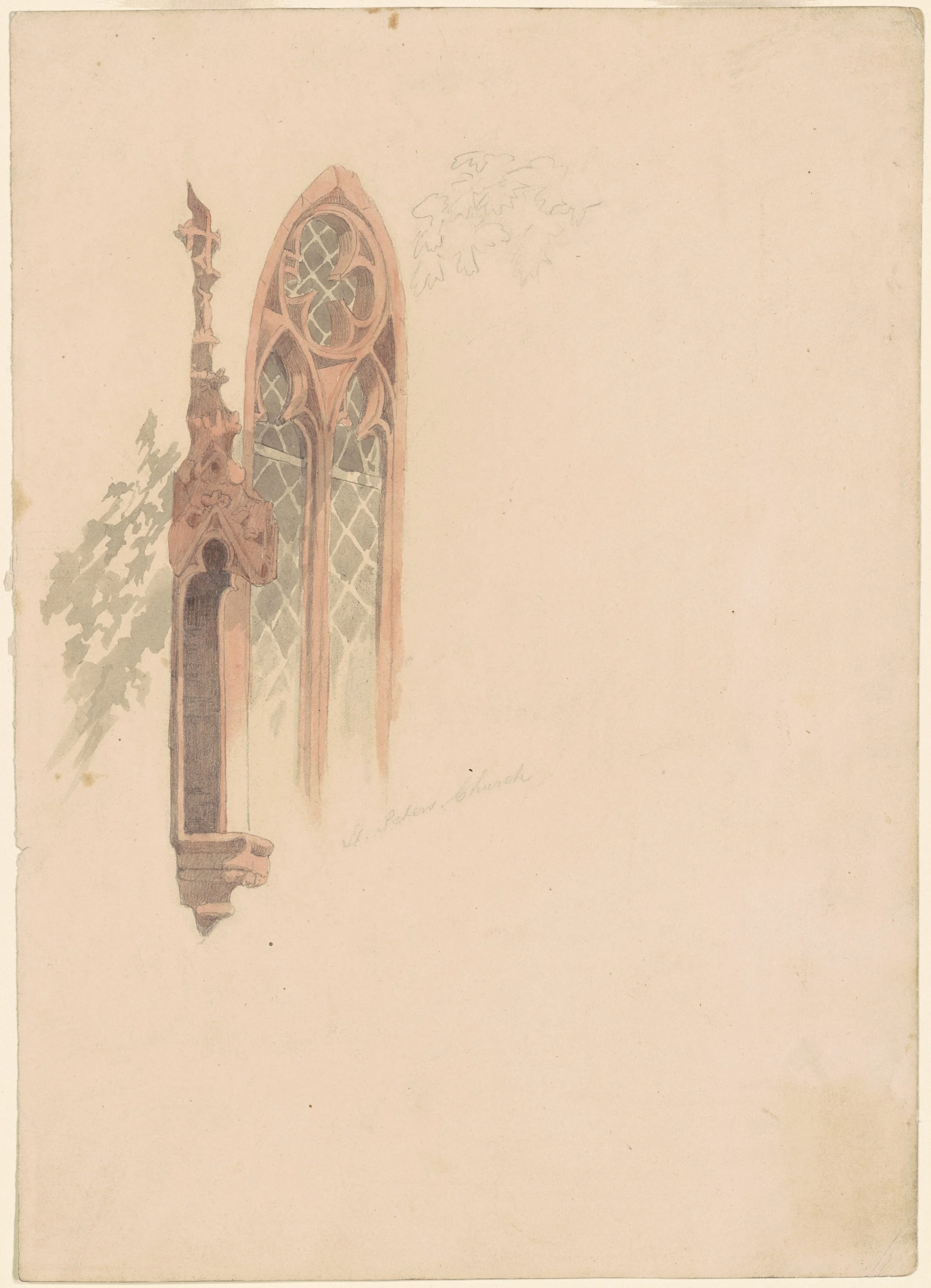
St. Peter's Church; c. 1840; American; Emanuel Gottlieb Leutze; Source: National Gallery of Art
CEFR Level B2-C1
I recently wrote about embodied learning and church seating. Windows are another part of church architecture that I think about often. Some of this is my personality affecting preferences and some of it is actual theological thought.
Caveat: These thoughts are about churches in the US where it is safe to openly worship the Christian God and where churches often have some form of control over how their spaces look.
My Experience
When I am in a room without windows, my skin crawls and my senses go on high alert. Anxiety simmers below the surface as I try to convince myself that I only feel trapped. Much of my mental focus goes to keeping my breathing steady and my social interactions reasonable. The perfect way to ensure that I am unlikely to hear or remember anything you say is to put me in a room without windows. Just as bad are windows at my back. Even if the windows are covered and no one can see in, it makes me feel vulnerable, like anyone could sneak up on me at any time.
I prefer windows that let me look out at nature, but windows to parking lots or stained-glass windows are an acceptable alternative. With stained-glass, I can see the light and have the sense that I could go through the window, if needed. Plus, stained glass makes pretty colors inside the room. I feel better and focus more when I’m in a pretty place.
What is not helpful are windows that are covered with dark boards, even custom-cut aesthetic ones because they still keep out the light. Let the light in! If what is happening in church suffers from being performed in the light, then maybe we need to re-think what we are doing.
If I struggle to focus in rooms without windows, then there must be plenty of other people who have similar experiences. I don’t say that because I think my experience is universal. I say it because I don’t think I’m so unique that no one else is like me.
Theological Thoughts
What do our churches' windows teach people about how we should think about light and darkness? When I walk into a church with no windows or windows that are covered, I wonder what they are trying to hide. As a teenager, I heard that casinos purposefully do not have windows or clocks so that people lose track of time. Are churches taking their cues from casinos, manipulating the space so people will be tricked into staying longer?
I was raised in traditions that shamed people for thinking parts of the service were boring or for wanting to leave on time. These traditions insisted that if you truly loved God, time would become meaningless the minute you stepped inside the church building. One day, I might write a rebuttal to that point of view. For today, I’ll simply ask why churches want to shame and manipulate people into spending more time there.
When I walk into a church that has no windows or covers their windows to keep out the light, I can’t help but think, “God is light. That’s why we worship in darkness. Don’t let in the light! Welcome Holy Spirit. But keep out the light!”
I also think, “Let your light shine before all - unless they are outside the building you designate as the place for your light and The Light of the World to be seen.”
I don’t think anyone makes decisions about windows with the intention of creating a theological lesson. All the same, when the physical space of a church directly contradicts the words spoken, it’s hard not to notice.
I can hear someone bringing up projectors and the need for darkness for words to be read. That’s a fair objection. Still, the question stands: Why have we integrated technology that causes us to worship a God of light by putting ourselves in darkness? Are the benefits of that technology greater than the spiritual lessons that are being taught by putting Christians into darkness? Could changing our understanding of what happens in church, how many people is ideal for a church, and so on allow us to both easily read the words and worship in the light?
I am also aware of the influences of ancient and regional architecture. Still, in times and places where we have a choice, why do we choose darkness and enclosure over light and freedom?
Like I said in the seating article, I don’t think everything has to have a spiritual meaning. At the same time, what we do in church is woven with spirituality. I don’t think we can honestly call church a sacred space and also dismiss this, that, and the other as irrelevant to how perceptions of the sacred are formed.
Take-Away Questions
Do our windows, or lack thereof, help people worship? How do we know?
What are we teaching people by the way we treat windows in our church?
Six 2-hour lesson plans to prepare a team to go on a vision or missions trip. Includes facilitator’s notes, suggested resources, and participant handouts. Participant handouts are limited to 12 copies. Please contact Jill Hames if you need more.
Please note: This is not a plug-and-play curriculum. These lesson plans assume the facilitator has background knowledge in the topics. Please see the syllabus and facilitator requirements below. You may also contact Jill Hames about scheduling a synchronous or in-person class with your group.
Leader Background
This training course is primarily designed for groups going on vision trips, as distinct from missions trips. Because of this, leaders are expected to be more knowledgeable than may be expected from leaders whose primary job is to wrangle a group and manage logistics.
This course could also be led by an outside facilitator to train leaders who will then form and train teams.
To lead a vision trip, the leader should have:
Familiarity with the different types of vision trips and understand the difference between vision trips and missions trips
Familiarity with intentional conversation techniques (e.g. Asset Based Community Development listening conversations) and ways to formulate useful questions
Personal experience in the host country
Personal contact with leaders at the host church(es)
Syllabus
Session 1: Why a Vision Trip?
Discover what we already know, or think we know, about the host country
Explore data that may challenge our assumptions about our country compared to theirs
Consider the difference between Christian mission and missions
Learn the difference between a vision trip and a missions trip
Plan for food and money needs on the trip
Session 2: Cultural Intelligence, Part 1
Discover what we know about our culture
Explore how the same thing can mean something different in different cultures
Learn to talk about how we talk
Consider definitions of the Gospel
Plan for clothing needs on the trip
Session 3: Cultural Intelligence, Part 2
Discover what we “just know” and how that changes when we go to another culture
Learn about high and low context cultures
Explore indicators and practices of high and low context cultures
Consider challenges we may face in a high/low context culture
Plan for hygiene needs on the trip
Session 4: Support and Partnership
Discover how we understand the difference between support and partnership
Explore the difference between support and partnership in the context of churches in different countries
Learn about historical problems in Western missions work
Consider how historical problems may/may not influence missions work today
Plan for medical needs on the trip
Session 5: How to Ask Questions
Discover our metrics for rudeness and politeness
Explore context and other clues for how different cultures perceive the rudeness or politeness of different interactions and actions
Learn how to ask useful questions (The 5 Ws, Question Formulation Technique, etc.), including listening to understand
Consider how to summarize what has been learned in these five sessions for a full assembly of the sending church(es)
Plan for what the group will actually be doing (listening conversations, group-led project, host-church-led projects, etc.)
Session 6: Involving the Sending Church(es)
Short group presentations on what has been discovered, learned, and discussed over the past five sessions
Time for prayer and sending rituals
Remind all of the team’s purpose and the role the sending church(es) will have on their return
Enjoy a social meal between the team and the sending church(es)
Anticipated Outcomes
Participants will be able to explain the difference between a vision and a mission trip.
Participants will be able to discuss the difference between Christian mission and missions.
Participants will be able to identify the challenges in defining the Gospel as distinct from Christian practices and cultural ideals.
Participants will be able to identify and discuss context clues to help them decipher subverbal communication.
Participants will be able to identify aspects of high and low-context cultures.
Participants will be able to discuss the similarities and differences between support and partnership.
Participants will be able to identify and use methods for creating useful questions.
Participants will be able to present, in a group, to a group about what they have learned.
Participants will be able to succinctly state the purpose of the trip.
PDF Download
This is a digital product, so I can't issue a refund. If you experience a problem, please let me know.