
The Hidden Biases of Leadership Training
Just because we give people leadership training, that doesn’t mean they’ve learned to be good leaders

Netsuke of Frog on a Straw Hat; Japan; 18th Century; Source: The Met
CEFR Level B2-C1
Updated and reposted August 2026
Originally published November 2025 on The Variety Page Limited and The Variety Page Circular
Freshman Year of College
“We could move that over there,” my new roommate contributed to the group’s effort to complete a task in our college’s optional leadership class for freshmen. For context, this was at an all-women’s college.
The group continued talking, asking each other what the next step would be.
“We could move that over there,” I said, trying to be louder than my roommate.
The discussion continued, bodies angled, not exactly with their backs to us, but not welcoming us into the circle, either. My roommate, tall and practical. Me, short and awkward. Neither of us dressed nor coiffed like our counterparts.
“We could move that over there,” a conventionally pretty woman suggested.
“Yes! Great idea! Let’s do it,” the group enthused.
“That’s what I said,” my roommate muttered, not so quietly that anyone listening wouldn’t hear.
Project completed, the facilitator gathered us to discuss how the project went. I waited for her to point out to the group that they could have finished minutes earlier if they had listened to everyone, to explain how they ignored someone on the edges of the circle. Instead, she highlighted how the group worked together, how listening to different ideas brought about the solution.
Alrighty then. If you aren’t popular and pretty and looking like everyone else, you don’t count. I didn’t need a special leadership class to teach me that.
Two Years Later
Two years later, I applied to be a resident advisor, the person responsible for a floor in the dorm. In the group interview, we were divided into groups and given the task of deciding who to give a scholarship to (as an exercise, not actually deciding someone’s future - at least, as far as I knew). The options were a woman from Latin America or a single mother from the US.
I had looked at a lot of scholarships before applying for college. I tried to remember the most common requirements or what demographic would qualify for most of them.
Another woman in my group suggested that we should give the scholarship to the woman from Latin America. I knew that was the expected answer. Even in my limited social experience, I had picked up the unspoken rule that North American help should always go to Latin American, African, or South Asian countries.
“We should give the scholarship to the single mother,” I interjected, “The woman from Latin America has her pick of schools that will give her a scholarship. Single mothers have a harder time paying for college.” Based on my scholarship research, I believed this to be true.
There were some half-hearted objections that single mothers in the US can work to pay for college but the person from Latin America really needs help and will add to the diversity of the school. It was clear the decision had been made and they were only responding to me out of politeness, so I didn’t bother voicing my next thought, “Single mothers also add diversity to a school filled with middle-class, childless college students supported by their parents. If we give the scholarship to her, then both women will be able to get an education, one here and one at another school.”
I saw the interview evaluator taking notes. I didn’t know if she was impressed with my unconventional suggestion, if she was unimpressed that I didn’t push harder for my choice, if she thought I was racist for not immediately picking the woman from another country, or if she wasn’t even paying attention to me. In the end, I wasn’t hired, whether because of this part of the interview or some other I don’t know.
These events taught me that for all my college talked about the importance of listening to everyone, the value of diversity, and the effectiveness of working together as a team, there were unexamined biases running the show and anyone who didn’t fit the designated role would be ignored. I didn’t need a class on unconscious bias. My experience taught me that such a thing exists, even if I didn’t know the official label for it until I was in my 30s.
Now
Throughout the years, I have had the opportunity to facilitate discussions. My college experiences were formative in how I go about that, including my admitting that my biases probably make it harder for someone else to speak up. In a church or ministry context, this is especially important because many people think that the leader of the group or the person with the title of minister or pastor must somehow know more about the topic or be spiritually more mature than the people attending the group. Lived experience proves that this assumption is not always true, and certainly not for all topics.
Here are my tips for anyone facilitating discussions.
Make sure you are capable of hearing everyone who speaks, even the quiet people.
If your role is to help people learn to listen to each other, then you have to be able to point out when the group ignores others. In any case, it’s your job to incorporate structures to help everyone be heard. What exactly that looks like will depend on the context and purpose of the conversation.
One suggestion is to ask, once the discussion comes to an end, “Who haven’t we heard from? Who spoke and feels like they were ignored?”
Be aware that people may not feel comfortable speaking up.
How will you both respect their agency to choose when to speak and also help to draw attention to their contributions when they are reluctant to put themself forward after speaking up once and being dismissed or ignored?
Self-reflect on what your priorities are.
What is the default answer in various situations?
Who do you think is worthy of your help and who do you think can manage on their own? What is the evidence for your conclusions?
What values go into your judgment about who deserves your attention?
Who might you be overlooking because you never took the time to think about what their life is like or because you assume they are like you?
It’s inevitable to have biases toward certain things, but be honest about it. Instead of “we value diversity,” say “we value diversity when that means people from different continents, not when it means people from different social contexts in our city.” Is that uncomfortable? Sometimes truth is uncomfortable, but truth is still better than deceit.
Honesty allows for reflection and growth and also helps prevent hypocrisy and double-standards. Honesty is especially important in a religion that claims to despise lies and to be the bringer of truth.
In Ministry
In a ministry context, self-evaluation and conscious inclusion is especially important because many people equate the church with God. If people in the church overlook or dismiss someone, it can feel like God doesn’t think they are important. It doesn’t matter how much you say “Jesus loves you” and “God thinks you’re special” if you talk over someone in Sunday School or never include them in after-church socializing. It doesn’t matter how much you say that a person is valuable and made just how God wants them and that God has given them a special calling if you only allow them to use that calling in very specific areas while others are allowed to use their callings wherever they want. Actions speak louder than words.
Remember how the Hebrews overlooked the Greeks in Acts 6? These Greek women converted to the Christian message that God thought they were important, then the people who claimed to share that belief ignored them. Of course they complained!
In your church context, who do you believe is included like everyone else but might actually be overlooked? What can you do to change that? Be very specific. There may need to be changes in the church culture, but while that is happening, what can you, as your own individual person, do to follow the example of Jesus who made sure to include the people the group dismissed?
As you start a new Sunday School quarter or Bible study or other class, pay attention to who speaks and who is quiet. What “just is” about how a class operates that might contribute to some perspectives being hidden? There are no simple answers that will magically make everyone feel welcome or free to participate, but if you see patterns, pay attention. Why do those patterns exist? What “just is” that maybe doesn’t have to be?
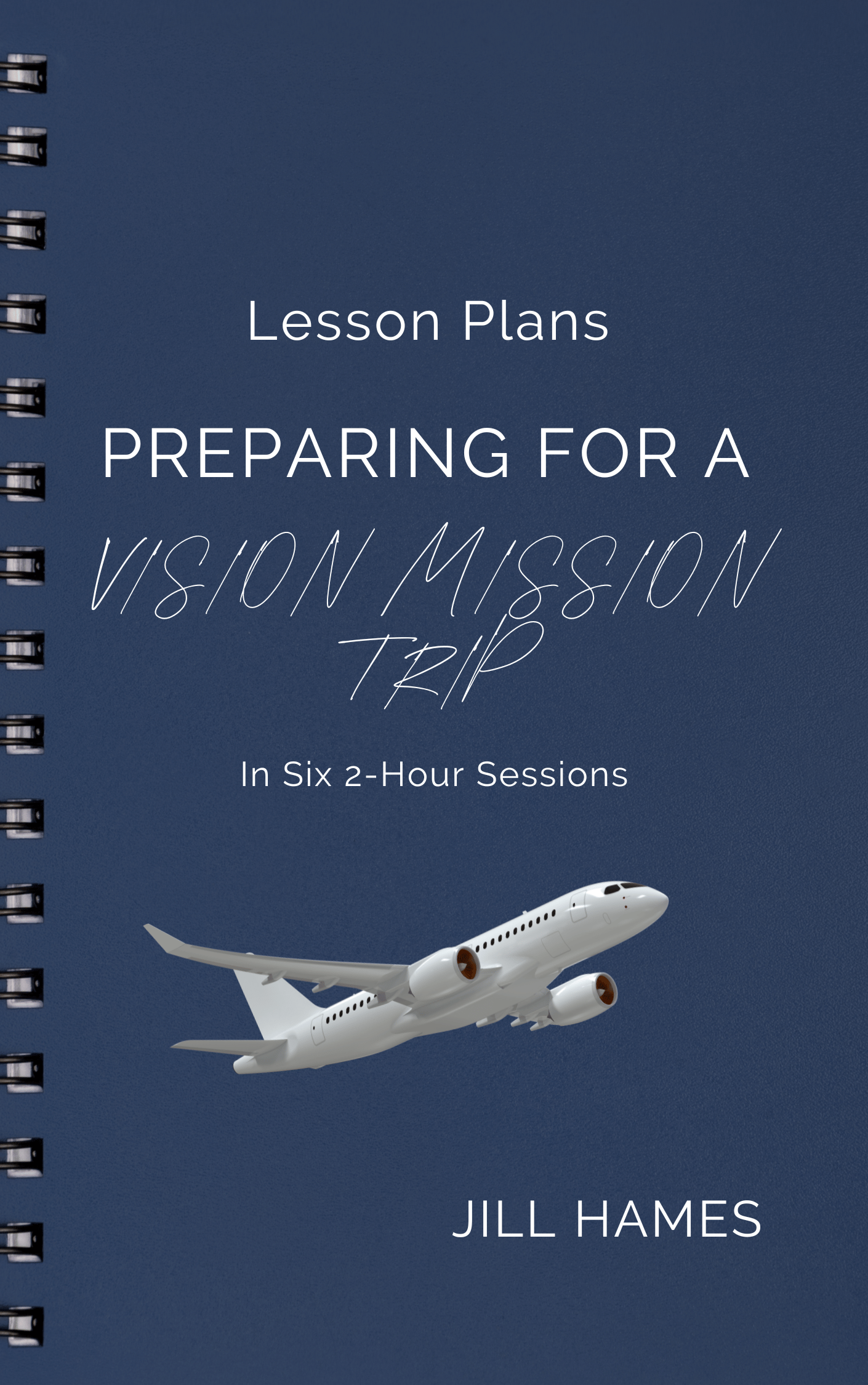
Six 2-hour lesson plans to prepare a team to go on a vision or missions trip. Includes facilitator’s notes, suggested resources, and participant handouts. Participant handouts are limited to 12 copies. Please contact Jill Hames if you need more.
Please note: This is not a plug-and-play curriculum. These lesson plans assume the facilitator has background knowledge in the topics. Please see the syllabus and facilitator requirements below. You may also contact Jill Hames about scheduling a synchronous or in-person class with your group.
Leader Background
This training course is primarily designed for groups going on vision trips, as distinct from missions trips. Because of this, leaders are expected to be more knowledgeable than may be expected from leaders whose primary job is to wrangle a group and manage logistics.
This course could also be led by an outside facilitator to train leaders who will then form and train teams.
To lead a vision trip, the leader should have:
Familiarity with the different types of vision trips and understand the difference between vision trips and missions trips
Familiarity with intentional conversation techniques (e.g. Asset Based Community Development listening conversations) and ways to formulate useful questions
Personal experience in the host country
Personal contact with leaders at the host church(es)
Syllabus
Session 1: Why a Vision Trip?
Discover what we already know, or think we know, about the host country
Explore data that may challenge our assumptions about our country compared to theirs
Consider the difference between Christian mission and missions
Learn the difference between a vision trip and a missions trip
Plan for food and money needs on the trip
Session 2: Cultural Intelligence, Part 1
Discover what we know about our culture
Explore how the same thing can mean something different in different cultures
Learn to talk about how we talk
Consider definitions of the Gospel
Plan for clothing needs on the trip
Session 3: Cultural Intelligence, Part 2
Discover what we “just know” and how that changes when we go to another culture
Learn about high and low context cultures
Explore indicators and practices of high and low context cultures
Consider challenges we may face in a high/low context culture
Plan for hygiene needs on the trip
Session 4: Support and Partnership
Discover how we understand the difference between support and partnership
Explore the difference between support and partnership in the context of churches in different countries
Learn about historical problems in Western missions work
Consider how historical problems may/may not influence missions work today
Plan for medical needs on the trip
Session 5: How to Ask Questions
Discover our metrics for rudeness and politeness
Explore context and other clues for how different cultures perceive the rudeness or politeness of different interactions and actions
Learn how to ask useful questions (The 5 Ws, Question Formulation Technique, etc.), including listening to understand
Consider how to summarize what has been learned in these five sessions for a full assembly of the sending church(es)
Plan for what the group will actually be doing (listening conversations, group-led project, host-church-led projects, etc.)
Session 6: Involving the Sending Church(es)
Short group presentations on what has been discovered, learned, and discussed over the past five sessions
Time for prayer and sending rituals
Remind all of the team’s purpose and the role the sending church(es) will have on their return
Enjoy a social meal between the team and the sending church(es)
Anticipated Outcomes
Participants will be able to explain the difference between a vision and a mission trip.
Participants will be able to discuss the difference between Christian mission and missions.
Participants will be able to identify the challenges in defining the Gospel as distinct from Christian practices and cultural ideals.
Participants will be able to identify and discuss context clues to help them decipher subverbal communication.
Participants will be able to identify aspects of high and low-context cultures.
Participants will be able to discuss the similarities and differences between support and partnership.
Participants will be able to identify and use methods for creating useful questions.
Participants will be able to present, in a group, to a group about what they have learned.
Participants will be able to succinctly state the purpose of the trip.
PDF Download
This is a digital product, so I can't issue a refund. If you experience a problem, please let me know.