
For the Love of Women: Book Review
Thoughts on Dorothy Littell Greco's new book

CEFR Level B2-C1
This is not a sponsored review. I completely read a book before I review it.
For the Love of Women by Dorothy Littell Greco (2025) is an accessible presentation on how misogyny is alive and well throughout US culture. The book’s focus is on healthcare, employment, government, media, relationships, and church. With 39 pages of end-note citations, this book is not unsubstantiated opinion. The evidence presented is backed by other evidence that readers can examine to see if they come to similar conclusions.
Greco discloses her religious bias up front. She then proceeds to write a book that anyone can benefit from. If a reader is looking for bible verses and Christian theological discussion, this book is not that. If the reader hopes for a discussion on the intersection of being a woman and multiple other factors, this book is not that. Again, this point is clearly stated in the introduction.
If a reader is looking for a systematic consideration of how an ideology affects seemingly unconnected actions, then this is the book to read. For the Love of Women would likely also interest readers who enjoy learning about US history, culture, and the ideas that shape culture.
In the first chapter, Greco writes “many people who engage in misogynistic behaviors or hold misogynistic beliefs don’t hate women” (4). In my experience, this is true. Some people care deeply about women, yet their actions betray a foundational belief that women’s “ideas, wants, needs, and experiences” (5) are less important than men’s. The example I thought of is how organizations often order “unisex” uniform shirts. I can’t speak to the male experience with these shirts, but I have yet to meet a woman who doesn’t complain about the fit. Not only is an ill-fitting shirt uncomfortable, it often leads to a woman feeling frumpy. Why should the men look polished and the women not? Before you dismiss a desire for properly fitting clothes as vanity, consider how a person’s appearance affects how much they are trusted, considered professional, or otherwise given advantages. I could go on with the ways “unisex” shirts disadvantage women, but I hope this brief example shows how making men the standard that women have to adapt to creates problems for women. If you think I’m making too much out of nothing, read the book.
Chapter 2 may confirm a woman’s experience in healthcare. Having serious physical symptoms dismissed as anxiety, being told the solution to floor-rolling pain is to tough it out without medication - the stories I personally know about go on and on. Chapter 2 helps explain the underlying history and assumptions that lead to such lack of care. It’s not that doctors are generally uncaring. It’s that they are trained in a system based on misogyny and that affects what they perceive as worth attention. Greco ends the chapter by advising healthcare providers to change to a response of, “I believe you and I’m going to help you figure this out” (44).
As the book examines the workplace, the government, and the church, the evidence of misogyny’s influence accrues. The refrain is the same: men’s needs, perspective, and reputation are prioritized. This prioritization makes life more challenging and dangerous for women. If you think I’m exaggerating, read the book.
For the Love of Women could be a depressing compilation of all the difficulties women experience and often accept as unchangeable. Thankfully, Greco uses the final two chapters to suggest ways to make things better. But first, she gives a warning. “The pursuit of healing [from the ways misogyny has harmed us] might lead to being misunderstood, rejected, or shamed” (144). Women know this to be true. Are men willing to take the risk to protect the women they claim to love?
In Chapter 8, Greco gives us hope. Andrew Bauman did what was necessary to change from someone who had “a low view of women” (144) to someone who “supports women and helps his brothers become ‘good and safe men’” (146). The chapter then addresses ways to begin the process of turning away from the familiar and towards healing and love of neighbor. What gives this chapter credibility is that Greco spends several pages addressing the reality that not all people positioning themselves as helpers can be trusted. This acceptance of the tension between hope and reality keeps her comments from feeling like chocolate bunnies - promising deliciousness, but full of air and lacking in robust flavor.
Readers who are already sympathetic to Greco’s premise may find the last chapter the most useful. The section that explains the difference between allies, advocates, and interrupters in the context of misogyny may be particularly helpful.
On the other hand, this chapter is the one where Greco’s religious beliefs are most prominent. She says, “without hope, our imaginations will be fettered” (183) and then expands “what we put our hope in matters” (184). The following paragraphs make it clear that she believes our hope should be in the Christian God’s desire to have a world filled with “healing, reconciliation, and justice” (184). Nevertheless, the book ends with a hopeful reminder that religious and secular people are working together to prioritize equality.
For the Love of Women could be read for purposes beyond personal enrichment. I could see this book being used as the foundation for a high school social studies class. Each chapter would allow the teacher to guide a discussion where students share their experiences and perspectives. That same format could be used in a bible study, if the facilitator were very brave and had training and experience in leading emotionally charged discussions.
For whatever reason For the Love of Women is read, it is worth reading and carefully considering the evidence presented. If a person lives in the US, they are affected by misogyny. If you don’t believe me, read the book.
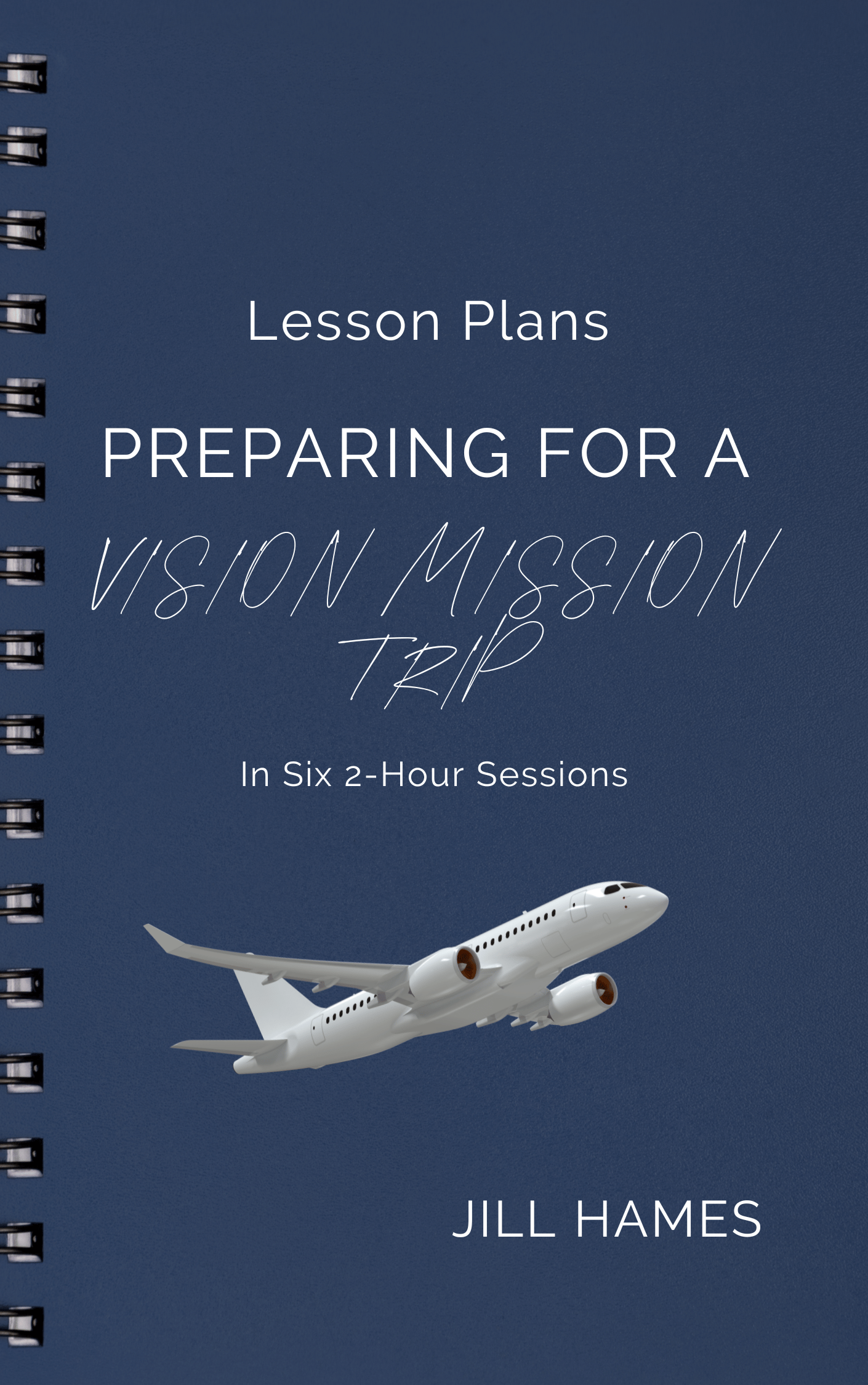
Six 2-hour lesson plans to prepare a team to go on a vision or missions trip. Includes facilitator’s notes, suggested resources, and participant handouts. Participant handouts are limited to 12 copies. Please contact Jill Hames if you need more.
Please note: This is not a plug-and-play curriculum. These lesson plans assume the facilitator has background knowledge in the topics. Please see the syllabus and facilitator requirements below. You may also contact Jill Hames about scheduling a synchronous or in-person class with your group.
Leader Background
This training course is primarily designed for groups going on vision trips, as distinct from missions trips. Because of this, leaders are expected to be more knowledgeable than may be expected from leaders whose primary job is to wrangle a group and manage logistics.
This course could also be led by an outside facilitator to train leaders who will then form and train teams.
To lead a vision trip, the leader should have:
Familiarity with the different types of vision trips and understand the difference between vision trips and missions trips
Familiarity with intentional conversation techniques (e.g. Asset Based Community Development listening conversations) and ways to formulate useful questions
Personal experience in the host country
Personal contact with leaders at the host church(es)
Syllabus
Session 1: Why a Vision Trip?
Discover what we already know, or think we know, about the host country
Explore data that may challenge our assumptions about our country compared to theirs
Consider the difference between Christian mission and missions
Learn the difference between a vision trip and a missions trip
Plan for food and money needs on the trip
Session 2: Cultural Intelligence, Part 1
Discover what we know about our culture
Explore how the same thing can mean something different in different cultures
Learn to talk about how we talk
Consider definitions of the Gospel
Plan for clothing needs on the trip
Session 3: Cultural Intelligence, Part 2
Discover what we “just know” and how that changes when we go to another culture
Learn about high and low context cultures
Explore indicators and practices of high and low context cultures
Consider challenges we may face in a high/low context culture
Plan for hygiene needs on the trip
Session 4: Support and Partnership
Discover how we understand the difference between support and partnership
Explore the difference between support and partnership in the context of churches in different countries
Learn about historical problems in Western missions work
Consider how historical problems may/may not influence missions work today
Plan for medical needs on the trip
Session 5: How to Ask Questions
Discover our metrics for rudeness and politeness
Explore context and other clues for how different cultures perceive the rudeness or politeness of different interactions and actions
Learn how to ask useful questions (The 5 Ws, Question Formulation Technique, etc.), including listening to understand
Consider how to summarize what has been learned in these five sessions for a full assembly of the sending church(es)
Plan for what the group will actually be doing (listening conversations, group-led project, host-church-led projects, etc.)
Session 6: Involving the Sending Church(es)
Short group presentations on what has been discovered, learned, and discussed over the past five sessions
Time for prayer and sending rituals
Remind all of the team’s purpose and the role the sending church(es) will have on their return
Enjoy a social meal between the team and the sending church(es)
Anticipated Outcomes
Participants will be able to explain the difference between a vision and a mission trip.
Participants will be able to discuss the difference between Christian mission and missions.
Participants will be able to identify the challenges in defining the Gospel as distinct from Christian practices and cultural ideals.
Participants will be able to identify and discuss context clues to help them decipher subverbal communication.
Participants will be able to identify aspects of high and low-context cultures.
Participants will be able to discuss the similarities and differences between support and partnership.
Participants will be able to identify and use methods for creating useful questions.
Participants will be able to present, in a group, to a group about what they have learned.
Participants will be able to succinctly state the purpose of the trip.
PDF Download
This is a digital product, so I can't issue a refund. If you experience a problem, please let me know.