
Money and Possessions: Book Review
Brueggemann shows that Bible has a lot to say about money and wealth
CEFR Level B2-C1
This is not a sponsored review. I completely read a book before I review it.
Background
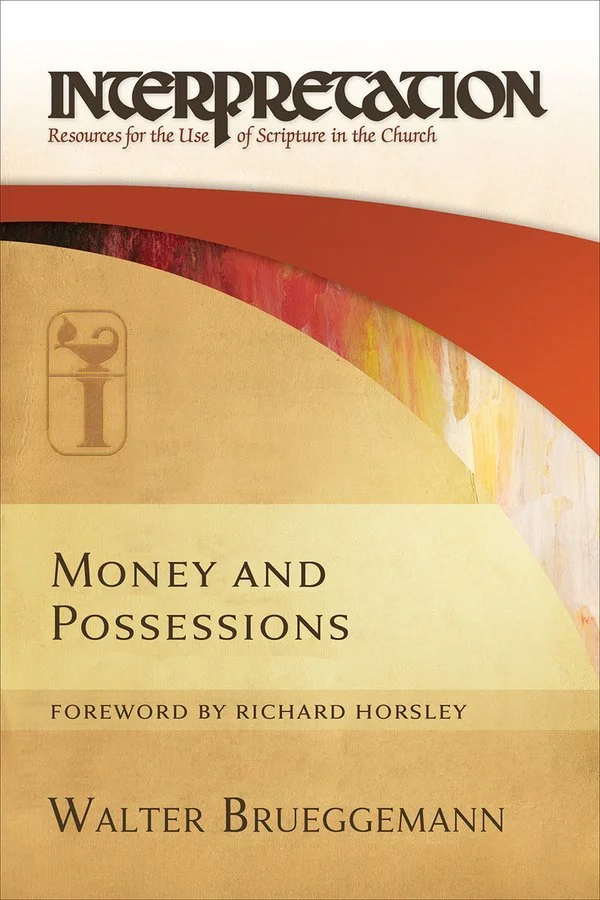
In a seminary class called Money and Ministry, we were assigned to read Money and Possessions by Walter Brueggemann. We then were told to write about the content and structure of the book, followed by our reflections. The whole paper had to be about 2,000 words. The trick was, we were supposed to focus on what we found valuable, not things we disagree with.* This is a long read, but I thought it may interest someone.
* Please don’t steal this professor’s assignment. 😇 I only share it to give context.
About the Book
In Money and Possessions, Walter Brueggemann mines the 66-book biblical canon for passages that say something about money. He is not literal with this search. For example, he does not limit himself to passages that have the keywords money, coin, wealth, etc. His purpose is more to find passages that speak to the concepts of money, which he expands to any physical thing that a society identifies as something valuable enough to trade for other valuable things, as evidenced by the title and the variety of scripture passages quoted throughout the book. I will use the term “money” as a shorthand for Brueggemann’s expanded definition.
In Chapter 1, Brueggemann introduces six theses: money is a gift from God (1), money is a reward for obedience [to God] (3), money belongs to God and humans are stewards (4), money is a source of social injustice (5), money should be shared with neighbors (6), and money tempts people to idolatry (8). These theses guide the discussion throughout the rest of the book.
Chapter 2 looks at the Israel narrative as a whole. This chapter lays a foundation for the following chapters that examine individual books. It is also a bridge between the theses and their supporting evidence. A summary of this chapter’s thesis is that the narrative arc of the Old Testament is one of “improper desire” causing confusion about what is proper to want (16).
Chapter 3 examines Deuteronomy’s list of laws and commandments. This chapter’s conclusion can be summarized as the Israelites learning a new cultural understanding of money. They were entering into a “covenantal faith” that was strange to them and different from the predatory economy they were used to (35). Chapter 3 is where Brueggemann’s theses start to gain evidence from specific books.
Chapter 4 tackles Joshua - 2 Kings. The evidence for Brueggemann’s theses accrues, assuming the reader can keep the list of theses in mind while parsing contenders for the world’s most complex sentences. To be fair to Brueggemann, complex topics sometimes need complex treatment. Chapter 4 can be summarized by Brueggemann’s claim that these six books show a change in the way Israel thought about God and their relationship with God. Israel went from depending on God for their food (a direct provision) to acknowledging God as the one who brings the rain and makes the crops grow (an indirect provision) (57).
Chapter 5 looks at Israel’s decline and eventual assimilation into the Persian empire (1-2 Chronicles, Ezra, and Nehemiah). The key lesson here is that although the controlling empire eventually allowed select Hebrews to return to Israel, it was with the understanding that the empire expected to decide who could be in charge of the small nation and those elite had better be sure Persia got its revenue (88). Israel, and its money, were beholden to a government that did not follow the covenantal economy.
Chapters 6 and 7 cover Psalms and Proverbs, respectively. In the psalms, Brueggemann sees the king taking the place of God, at least when it comes to the role of direct or indirect provider (108). Proverbs is harder to summarize because it is a collection of observations about the way life is or statements about what the ideal life would look like. After establishing that Proverbs advocates for neither poverty nor wealth (119), Brueggemann then focuses on the proverbs that show how many problems come from greed. Bad things come to the person who is greedy for gain, and to the community they are in (124).
Chapter 8 brings us to the books commonly called “The Prophets.” The sayings in these books protest the normal, the obvious, the way things just are. According to Brueggemann, this collection of books offers the option of an economy that was ruled by the God of “covenant and the guarantor of justice” and this option would have seemed strange and certain to fail to people accustomed to a king being the provider and arbiter of justice (140).
Chapter 9 collates the remaining Old Testament books. According to Brueggemann, Ruth shows humans, God, and social systems working together to provide for the vulnerable (166). Song of Songs shows men focusing on a woman’s economic value while the woman refuses to commodify her sexuality (168). Ecclesiastes has what 21st-century western culture might call a balanced approach to money - it is amoral and it might as well be used to make life easier because it will not help a person when they are dead (174). Lamentations is about the grief of losing what once was had and has no happy ending the way there is in Job (179). Esther highlights a man thinking about women as objects for him to use and women refusing to be objects, opting instead for self-agency (180-182).
Finally, over halfway through the book, Brueggemann takes us to the New Testament, starting with the Gospels in Chapter 10. This chapter highlights how much Jesus had to say about money. On page 193, Brueggemann concludes that disciples of Jesus are not to be motivated by scarcity. This ties the chapter back to his theses that money should be shared with neighbors, that God owns the money and humans only use it, and that money is a gift from God.
Chapters 11 and 12 look at Acts and the writings attributed to Paul for clues about how early Christians lived out the teachings of Jesus once Jesus was no longer physically present. Key themes here are that early Christians had to change from a mindset of economic hierarchy to one of neighborly care (206) and that a mindset of scarcity leads to divisions (226).
The final three chapters further explore how the early church lived in a hierarchical, status-based economy while holding religious values of equality and economic generosity. Brueggemann concludes that attempting autonomy, such as an Empire may do, is a recipe for self-destruction (268). Thoughtful readers will understand that his six theses are a path to self-preservation.
My Thoughts
Money is a gift from God (1). This summarizes Brueggemann’s first thesis and is a concept with implications that I have thought about for years. The second thesis of money being a reward (3) is related, but due to space constraints, I will only address the first.
If a person believes that God made everything, either directly or indirectly, then that makes God the owner of everything unless God gives it away. In that sense, possession of anything is a gift. Beyond the Genesis and Psalm passages Brueggemann references in Chapter 1, the parables of the vineyard owner and the day laborers, the bags of gold/talents, and others suggest that, at least sometimes, money is gifted by God.
The problem is looking a poor person in the eye and saying, “Money is a gift from God.” To which they will naturally reply, “So why didn’t God see fit to gift me with enough?” And just like that, the conversation lands in the complex territory of sin, free will, and God’s sovereignty.
I have yet to find a satisfying answer to the poor person’s reasonable question. The best I could do right now is to say that money is a gift from God in the most fundamental sense, but functionally, the effect of humans choosing contrary to God’s will means that the gift is not used how God intended. Because God allows humans to choose how to use what God gives them, and because humans often choose uses that harm themselves and others, poverty has resulted. Even though I am unsatisfied with that explanation, I still think the negative effects on people’s view of themselves and God can be serious enough that the message of money being a gift needs to be taught with transparency about the challenging questions it brings up.
On page 17, Brueggemann says, “The neighbor is a line that must not be transgressed, because the neighbor is an undeniable social fact that will not go away.” What would happen if every sermon included this sentiment in its introduction and conclusion, along with the scripture passages for the sermon? Beyond presenting compositional challenges for sermon-writers, I suspect that it would ground every passage of scripture in a God-human-human triangle. The scripture puts the listeners’ minds on God. The reminder that all living persons are in neighborly relationships would force people to confront the fact that they think of some people as not their neighbors. The assumption here is that preachers and listeners would take Jesus at his word when he defines a neighbor as the person most despised, with the implication being that the word also includes people in a person’s in-group. My hypothesis is that regularly reminding people of the God-human-human triangle would be a safeguard against, and a challenge to, God-human and human-human linear theologies.
Brueggemann’s proposal that Acts does not show a literal communal life among Christians but rather an approach to economics that flattened social hierarchies (206) removes some questions the “commune” perspective brings. For starters, ignoring the more extreme religious examples, I have seen the “communal” interpretation only apply on Sunday. There is a church in my town that has teaching, prayer, and a communal meal every Sunday in an attempt to mimic what is described in Acts. My question is how they decided that description only applies during Sunday services. Accepting Brueggemann’s proposal eliminates this contradiction between Christian life on Sunday and the rest of the week.
Secondly, if Christians believe the people in Acts literally had no personal possessions, then there are questions about what happened outside of the small group Acts reports on, particularly as Christianity expanded outside of Palestine and to more non-Jews. Further, even a cursory knowledge of early Church history suggests that people regularly owned their own property. Brueggemann’s answer to these difficulties is to confirm that even the earliest Christians maintained private possessions, as shown by Paul having a house of his own (217).
Accepting a possibility other than a literal understanding of “everything in common,” frees up mental energy for understanding the implications of the early Church’s practices. The social implication, the “why,” is more transferable across time and culture than the precise mechanics, the “how.” It also puts the focus on outcome rather than practice. There is not room here to discuss the benefits of that change in focus.
Brueggemann interprets 2 Corinthians 9:6-8 as Paul suggesting generosity as an antidote to, and a guard against, extortion (222). My summary is that Paul says to give generously and cheerfully because God gifted a person’s things to them and they want to imitate God, not because they feel compelled to repay a favor/debt or because social expectations require it. This reminded me of church-sponsored charity programs that expect recipients of food, clothing, or housing to repay the church by attending services. When I challenged this, the response was a shrug and, “We did something nice for them; they should want to do something for us.” I wonder if such attitudes and programs would exist if giving were seen as imitating God rather than a social-economic transaction. That, of course, brings up the question of how a person understands God and God’s relationship to humans. Again, there is not room to explore this here.
I have focused primarily on the Old Testament and the writings attributed to Paul partly because that is where I made the most notes while reading and partly because I keep running into people who seem to conflate Paul with Jesus. Being able to introduce a different perspective to consider when reading Paul seems like a valuable starting place in those contexts.
If it matters, I got full marks on this assignment.

Six 2-hour lesson plans to prepare a team to go on a vision or missions trip. Includes facilitator’s notes, suggested resources, and participant handouts. Participant handouts are limited to 12 copies. Please contact Jill Hames if you need more.
Please note: This is not a plug-and-play curriculum. These lesson plans assume the facilitator has background knowledge in the topics. Please see the syllabus and facilitator requirements below. You may also contact Jill Hames about scheduling a synchronous or in-person class with your group.
Leader Background
This training course is primarily designed for groups going on vision trips, as distinct from missions trips. Because of this, leaders are expected to be more knowledgeable than may be expected from leaders whose primary job is to wrangle a group and manage logistics.
This course could also be led by an outside facilitator to train leaders who will then form and train teams.
To lead a vision trip, the leader should have:
Familiarity with the different types of vision trips and understand the difference between vision trips and missions trips
Familiarity with intentional conversation techniques (e.g. Asset Based Community Development listening conversations) and ways to formulate useful questions
Personal experience in the host country
Personal contact with leaders at the host church(es)
Syllabus
Session 1: Why a Vision Trip?
Discover what we already know, or think we know, about the host country
Explore data that may challenge our assumptions about our country compared to theirs
Consider the difference between Christian mission and missions
Learn the difference between a vision trip and a missions trip
Plan for food and money needs on the trip
Session 2: Cultural Intelligence, Part 1
Discover what we know about our culture
Explore how the same thing can mean something different in different cultures
Learn to talk about how we talk
Consider definitions of the Gospel
Plan for clothing needs on the trip
Session 3: Cultural Intelligence, Part 2
Discover what we “just know” and how that changes when we go to another culture
Learn about high and low context cultures
Explore indicators and practices of high and low context cultures
Consider challenges we may face in a high/low context culture
Plan for hygiene needs on the trip
Session 4: Support and Partnership
Discover how we understand the difference between support and partnership
Explore the difference between support and partnership in the context of churches in different countries
Learn about historical problems in Western missions work
Consider how historical problems may/may not influence missions work today
Plan for medical needs on the trip
Session 5: How to Ask Questions
Discover our metrics for rudeness and politeness
Explore context and other clues for how different cultures perceive the rudeness or politeness of different interactions and actions
Learn how to ask useful questions (The 5 Ws, Question Formulation Technique, etc.), including listening to understand
Consider how to summarize what has been learned in these five sessions for a full assembly of the sending church(es)
Plan for what the group will actually be doing (listening conversations, group-led project, host-church-led projects, etc.)
Session 6: Involving the Sending Church(es)
Short group presentations on what has been discovered, learned, and discussed over the past five sessions
Time for prayer and sending rituals
Remind all of the team’s purpose and the role the sending church(es) will have on their return
Enjoy a social meal between the team and the sending church(es)
Anticipated Outcomes
Participants will be able to explain the difference between a vision and a mission trip.
Participants will be able to discuss the difference between Christian mission and missions.
Participants will be able to identify the challenges in defining the Gospel as distinct from Christian practices and cultural ideals.
Participants will be able to identify and discuss context clues to help them decipher subverbal communication.
Participants will be able to identify aspects of high and low-context cultures.
Participants will be able to discuss the similarities and differences between support and partnership.
Participants will be able to identify and use methods for creating useful questions.
Participants will be able to present, in a group, to a group about what they have learned.
Participants will be able to succinctly state the purpose of the trip.
PDF Download
This is a digital product, so I can't issue a refund. If you experience a problem, please let me know.